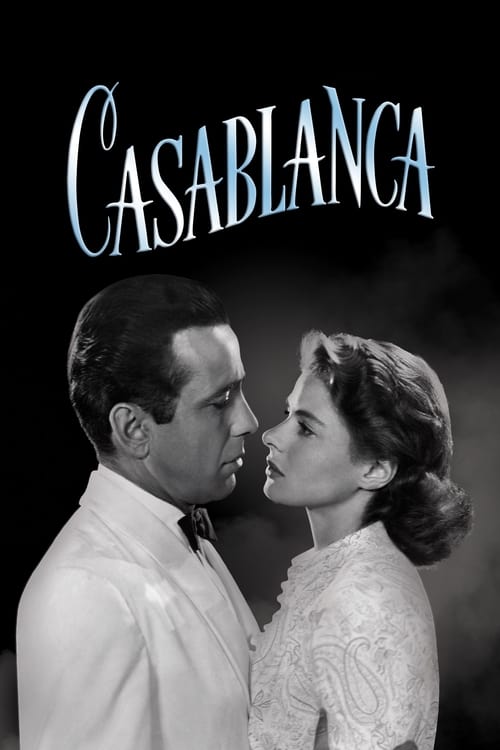
Casablanca (1943)
Directed by Michael Curtiz
No · Ultra Based
How we score movies →Consciousness Markers
The female lead is portrayed as passive and ultimately deferential to male decision-making. She is removed from the narrative's resolution, sent away while the men pursue their purposes.
The cast is predominantly white with no meaningful representation of non-European characters. The colonial setting of Morocco is treated as mere backdrop without any indigenous representation.
No interrogation of race or colonial dynamics. The Moroccan setting is treated as neutral geography with no engagement of power structures or indigenous representation.
While the film depicts resistance to Nazism, it contains no critique of capitalism or systemic economic structures.
Minimal preachy moralizing about social issues. Political content is embedded within the narrative rather than presented as explicit messaging.
No LGBTQ+ themes or representation present in the film.
No environmental themes or climate-related content in the film.
No body positivity themes. The film adheres to standard 1940s Hollywood conventions regarding appearance and bodies.
No representation of neurodivergence or related themes in the film.
The film portrays WWII and the Resistance in straightforward historical terms without revisionist intent or reinterpretation.


Synopsis
In Casablanca, Morocco in December 1941, a cynical American expatriate meets a former lover, with unforeseen complications.
Why it received this score
Casablanca stands as a monument to classical Hollywood craftsmanship, which is precisely why its cultural consciousness registers as nearly inert on modern scales. The film concerns itself with duty, sacrifice, and the moral imperative to oppose Nazism, themes that carry weight but lack any engagement with the social justice frameworks that define contemporary progressive sensibility. The narrative unfolds as a love triangle resolved through masculine decision-making, with Ilsa reduced to an object of competing male desires rather than an agent of her own fate. Her final scene sees her literally removed from the picture, sent away while the men pursue their larger purposes.
The casting reflects the Hollywood of its era: overwhelmingly white, with supporting players drawn from European immigrant communities. The film's setting in colonial Morocco is treated as mere geography, a neutral backdrop for the drama of white male conscience. There is no interrogation of power structures, no acknowledgment of the colonial context, no representation of the indigenous population as anything other than set dressing. The resistance movement itself, while positioned as morally correct, is never subjected to any ideological scrutiny or critique of systemic power.
What emerges is a film of genuine artistic merit engaged in none of the self-conscious social auditing that marks contemporary cinema. It tells its story with the confidence of an era that had not yet internalized the obligation to examine its own assumptions about who deserves to be centered, whose stories matter, and what constitutes progress. This is not a criticism of the film's quality but rather an observation about the vast distance between 1943 sensibilities and those of the present moment. The film remains what it was: a perfectly constructed entertainment untouched by the cultural consciousness that would eventually reshape American storytelling.
Analysis generated by our Consciousness Algorithm
Critic Reviews
“The dialogue is so spare and cynical it has not grown old-fashioned. Much of the emotional effect of Casablanca is achieved by indirection; as we leave the theater, we are absolutely convinced that the only thing keeping the world from going crazy is that the problems of three little people do after all amount to more than a hill of beans.”
“Much more fun than its stuffy "Greatest Film Ever Made" tag suggests, with a literate script, stylish direction, a great song and cinema's most romantic couple in Bogie and Bergman.”
“Casablanca accomplishes that which only a truly great film can: enveloping the viewer in the story, forging an unbreakable link with the characters, and only letting go with the end credits.”
“Ingrid Bergman makes a charming and beautiful refugee and Paul Henried gives a convincing performance in the role of the ardent anti-Nazi leader. Claude Rains gives one of his best performances as the police chief and Conrad Veidt is properly menacing as the Nazi officer. Sydney Greestreet is wonderful as the slick proprietor of the Blue Parrot and Rick’s rival in the cafe business.”