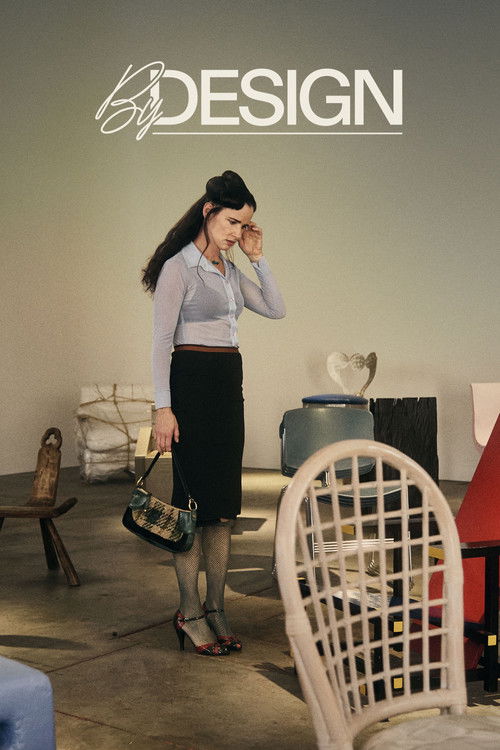
By Design (2026)
Directed by Amanda Kramer
Yes · Woke
How we score movies →Consciousness Markers
The film's entire premise functions as commentary on female objectification and the reduction of women's bodies to aesthetic objects or commodities. Critics have identified it as a wry interrogation of how women are perceived and valued.
The ensemble includes Mamoudou Athie and actors of various backgrounds in meaningful roles. The casting reflects contemporary diversity sensibilities, though the focus remains on Juliette Lewis as the protagonist.
The film explicitly engages with commodity fetishism and the reduction of human value to market logic. The chair as object of desire and the woman's body as vessel for others' needs speaks directly to capitalist objectification.
The film's body-swap premise invokes questions about bodily autonomy and the relationship between body and self. However, this operates more as philosophical inquiry than body-positive celebration or representation.
Critics note the film raises 'unnerving questions' about love, friendship, and social value, but describe it as formally inventive and playful rather than preachy. The satire operates through absurdist narrative rather than explicit moralizing.
While the cast includes Black and non-white actors, the film's thematic focus is on gender and class rather than racial dynamics. No evidence suggests the narrative engages with racial consciousness as a central concern.
No explicit LGBTQ+ themes are evident in available plot summaries or critical discussions. The film engages with heteronormative structures through its protagonist's positioning, but does not foreground queer identity or relationships.
No climate-related themes are present in the film. The narrative concerns interpersonal relationships and philosophical questions about identity and value.
No neurodivergent representation or themes are evident from available information about the film.
The film is a contemporary surrealist drama with no historical setting or narrative. Revisionist history does not apply.
Synopsis
A woman swaps bodies with a chair, and everyone likes her better as a chair.
Why it received this score
Amanda Kramer's "By Design" presents itself as a philosophical satire wrapped in the absurdist conceit of a woman swapped into a designer chair. The premise is deliberately provocative, and Kramer deploys it with the precision of a surgeon wielding a very expensive scalpel. What emerges from the film's surreal framework is a meditation on how women become objects in the economies of desire, domestic labor, and social positioning. Juliette Lewis, restricted to stillness as the chair-bound consciousness, carries the film's central observation: that when a woman ceases to perform the emotional and social labor expected of her, those around her realize they preferred her when she was useful rather than present.
The film's formal approach resists hectoring its audience. Critics have noted its theatrical artifice, its investment in production design, and its refusal of conventional sentiment. This is where "By Design" distinguishes itself from more explicitly preachy progressive cinema. Rather than staging speeches about objectification, Kramer stages the absurd reality of it. A woman loses her body and becomes more desired. Her friends bond with her body while she inhabits an inanimate object. The comedy is grim, and the observation cuts deeper for being delivered through surrealist narrative rather than earnest dialogue. The film also engages with the reduction of human value to commodity logic, tracking how capitalism transforms both bodies and objects into interchangeable vessels for social desire.
Yet the film operates within certain constraints. Its focus on gender objectification does not substantially interrogate racial dynamics or other vectors of social power. The cast is diverse, but the script's concerns remain centered on the particular experience of a woman coded as white navigating affluent social circles. The film's philosophical inquiry into identity and bodily autonomy, while sophisticated, stops short of making explicit claims about systemic inequality. What remains is a formally inventive work that uses surrealism to defamiliarize the ordinary cruelties of social positioning, particularly for women, without necessarily constructing a comprehensive analysis of how those cruelties connect to broader structures of power.
Analysis generated by our Consciousness Algorithm
Critic Reviews
“The insights and artistic inclinations that populate Kramer’s work aren’t for everyone, and there’s a good chance By Design won’t connect with most viewers. But the alienating nature of the premise is what makes it fascinating, pushing us to question how we want to be seen and experienced as people in the world. ”
“It’s a pointedly strange experience, sometimes annoyingly so and sometimes unexpectedly crushing, but all enjoyably kooky depending on your tolerance for this kind of thing.”
“The film often feels as impossible to definitively grasp as the coveted furniture that it follows — but whether that’s a feature or a bug lies in the eye of the beholder.”
“Inspired by objectification, By Design, by design, tests the patience of viewers via Kramer’s precise direction and controlled mise-en-scène, designed by Grace Surnow and photographed by Patrick Meade Jones––unfortunately, the challenge never feels rewarding. Perhaps that’s the point: aspirational luxury sells the sizzle, not the steak.”