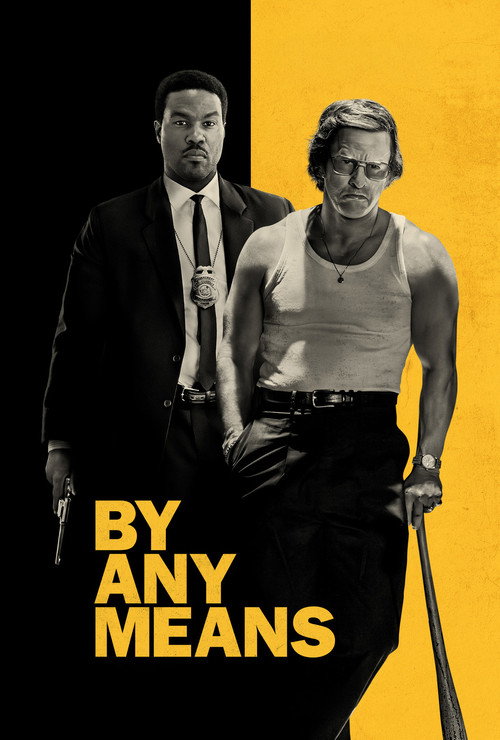
By Any Means (2026)
Directed by Elegance Bratton · $13.5M domestic
Partly · Woke-Adjacent
How we score movies →Consciousness Markers
The film is built around the murder of civil rights leaders in Jim Crow Mississippi, with the opening act depicting poll taxes and voter suppression. Reviewers explicitly drew lines between the film's historical setting and contemporary American voting rights debates.
The film inserts a fictional white mafia hitman as a primary agent of racial justice into the real story of Vernon Dahmer's murder, a choice his family publicly condemned. It also appropriates Malcolm X's phrase 'By Any Means Necessary' and applies it to a white mob enforcer beating Klansmen, a reframing that attracted pointed criticism across the political spectrum.
A Black lead actor plays the central FBI agent in a 1960s civil rights drama directed by a Black filmmaker. The casting is historically motivated and narratively coherent, though the film's structure ultimately subordinates that lead to a white co-star's violent agency.
The film's opening focus on Jim Crow voter suppression carries a contemporary political charge that reviewers connected to modern voting rights debates. However, the dominant mode is action-thriller rather than sermon, limiting the score.
Homophobic taunts appear as an interrogation tactic deployed against Klansmen, noted by critics as crude exploitation-style writing. This is not affirmative representation but an incidental, uncomfortable presence.
No feminist themes, gender politics, or notable female-empowerment framing are present in the available material. The story is a male-driven buddy-action thriller.
No climate, environmental, or ecological themes are present in this 1960s-set crime thriller. None.
No anti-capitalist or class-critique framing is evident. The antagonists are racial terrorists, not corporate villains.
No body positivity themes or commentary are present. The film does not engage with this marker in any discernible way.
No neurodivergence themes or representation are present. The film shows no interest in this marker.
Synopsis
In 1960s Mississippi, young Black FBI agent Wayne Strider is sent to investigate a wave of brutal killings targeting civil rights leaders. Forced to work alongside notorious mafia hitman Greg Scarpa, Strider finds himself pulled into a deadly hunt where the lines of justice and vengeance begin to blur.
Why it received this score
*By Any Means* arrives as a film that cannot quite decide what it wants to be, and commits to all of its identities with equal conviction. It is a prestige civil rights drama. It is also a buddy-cop revenge thriller. It is a meditation on justice and institutional failure. It is also Mark Wahlberg hitting Klansmen with a baseball bat. Director Elegance Bratton, whose autobiographical debut *The Inspection* was a genuinely precise piece of filmmaking, here navigates a screenplay that appropriates Malcolm X's most famous phrase and hands it, along with most of the cathartic violence, to a white mobster with a criminal record that predates the film's events by several decades. The family of Vernon Dahmer, the real NAACP leader whose murder anchors the narrative, has noted that the story was always about voting rights. The film has noted that there are baseball bats.
The racial consciousness on display is not subtle. Jim Crow voter suppression, murdered civil rights leaders, and the spectacular impotence of federal institutions are all present and correctly identified as bad. Where the film earns its more contested marks is in its approach to revisionist history: the decision to resolve the moral weight of 1960s Mississippi through the extracurricular violence of an organized crime figure is a storytelling choice that critics have compared, unfavorably, to *Green Book* and *Mississippi Burning*, two films that did not require a mafia hitman to make their points but did require a white man in the foreground. The comparisons are unkind and not entirely unfair.
What is genuinely interesting about *By Any Means* is the specific discomfort it produces, which is not the discomfort of a challenging film but the discomfort of a film that is challenging in the wrong direction. It is historically conscious without being historically rigorous. It is racially aware while structuring its plot so that awareness requires a cosigner. Bratton is a filmmaker of evident talent working from material that has already made several decisions he cannot unmake. The result is a film that scores meaningfully on racial consciousness and revisionist history, modestly on lecture energy, and sits at zero on everything else, which is either a sign of focus or a sign that fifteen production companies could only agree on so much.
Analysis generated by our Consciousness Algorithm
Critic Reviews
“Those already on board with its message about America’s past sins will undoubtedly enjoy the protagonists’ quest for justice, and the riveting packaging might also introduce its historical subject matter to a few of the uninitiated.”
“His co-star may be skimming the surface, but Abdul-Mateen II goes to labyrinthine lengths, damn near every minute, to get to the real soul of this material.”
“Bratton and scriptwriter Sascha Penn artfully straddle the various divides and historical animosities while delivering a propulsive, muscular and unvarnished action thriller, a sort of “Mississippi Burning” for a new generation. ”
“The movie’s glib and muted in its impact, right from the start. Screenwriter Penn makes the bickering cliched and the actors do nothing to stop him.”