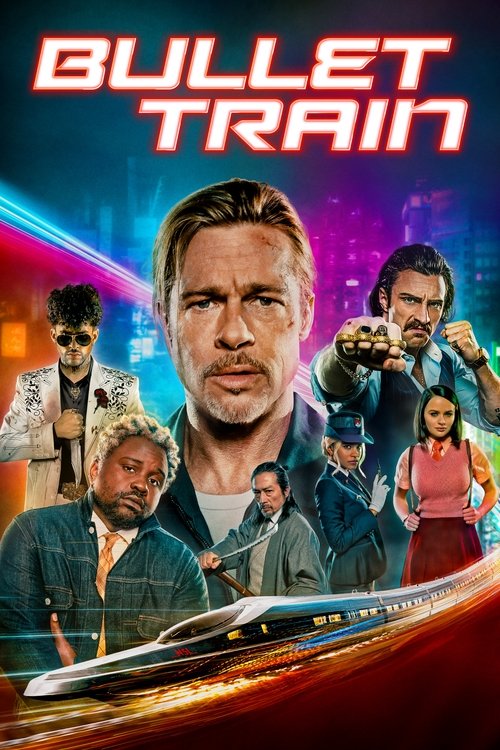
Bullet Train (2022)
Directed by David Leitch
No · Ultra Based
How we score movies →Consciousness Markers
The ensemble cast is notably multiethnic with prominent roles for actors of Black, Asian, Latino, and other backgrounds. However, the film displays no awareness of this diversity and treats it as incidental to the plot.
While the film features racial diversity in casting, it demonstrates no conscious engagement with racial themes or dynamics. The whitewashing controversy was addressed defensively rather than explored thematically.
Joey King plays the primary antagonist with agency and cunning, but the film offers no broader feminist critique or examination of gender dynamics.
The protagonist's 'bad luck' curse functions as a comedic character trait but does not constitute representation of neurodivergence in any meaningful sense.
No LGBTQ themes, characters, or representation are present in the film.
No climate-related themes or environmental consciousness appear in the film.
The film treats capitalist violence and assassination as neutral entertainment. No critique of economic systems or class structures is present.
No body positivity themes are evident. The film features conventional action star physiques without commentary on body diversity.
The film contains no historical elements or revisionist historical narratives.
The film maintains a purely entertainment-focused approach with no preachy messaging or lectures about social issues.


Synopsis
Unlucky assassin Ladybug is determined to do his job peacefully after one too many gigs gone off the rails. Fate, however, may have other plans, as Ladybug's latest mission puts him on a collision course with lethal adversaries from around the globe—all with connected, yet conflicting, objectives—on the world's fastest train.
Why it received this score
Bullet Train presents the peculiar case of a film that assembles a strikingly multiethnic ensemble cast while maintaining almost complete indifference to the social implications of such a choice. The movie features actors of various racial and ethnic backgrounds—Brian Tyree Henry, Andrew Koji, Hiroyuki Sanada, and Bad Bunny among them—yet treats this diversity as mere happenstance, a product of assembling assassins from "around the globe" with no particular investment in what that phrase might signify. The director and screenwriter have acknowledged the whitewashing concerns surrounding the casting of predominantly non-Japanese actors in a story set in Japan, but the film itself offers no commentary on this tension. The characters exist in a vacuum of cultural awareness, their backgrounds serving purely as costume pieces.
The film's ideological posture is fundamentally apolitical, content to be nothing more than an action comedy about criminals shooting at one another on a train. There is no feminist agenda to speak of, no LGBTQ representation, no climate consciousness, no examination of class struggle, and no particular interest in neurodivergent representation beyond the central conceit that the protagonist suffers from bad luck. The screenplay has no interest in interrogating the structures within which these assassins operate, treating capitalism and violence as the mere furniture of entertainment rather than systems worthy of examination.
What we encounter is a 2022 film that has inherited contemporary casting practices without inheriting contemporary sensibilities. It is diverse in form while remaining inert in substance, a movie that demonstrates how easily multicultural casting can be deployed as visual texture while actual engagement with social consciousness remains entirely optional. The film succeeds as spectacle and fails utterly as cultural commentary, which is to say it succeeds entirely according to its own modest ambitions.
Analysis generated by our Consciousness Algorithm
Critic Reviews
“Bullet Train feels like someone crossbred Kill Bill with a Final Destination movie. And at times, David Leitch’s film is almost as glorious as that description makes it sound — elaborate and ridiculous but dedicated to making the elaborate and the ridiculous feel … well, not plausible, exactly, but certainly compelling and fun.”
“Unlike so many of the cookie-cutter, wisecracking-assassin movies in recent memory, Bullet Train acknowledges its outlandishness from the beginning and yet also manages to connect so many dots in creative, gotcha fashion.”
“Leitch embarks on a series of adrenalized set pieces that defy logic and physics so breezily that its relentless, ridiculous violence plays more like a winsome ballet.”
“As a motor-mouthing smart-ass, the 58-year-old Pitt is badly miscast – every detail here seems tailored to Ryan Reynolds, director David Leitch’s Deadpool collaborator – while the film's bulging cast and bloated running time recalls those all-star capers of the 1960s: imagine It's a Mad, Mad, Mad, Mad World crossed with a migraine. For the sake of all that’s holy, take the bus.”