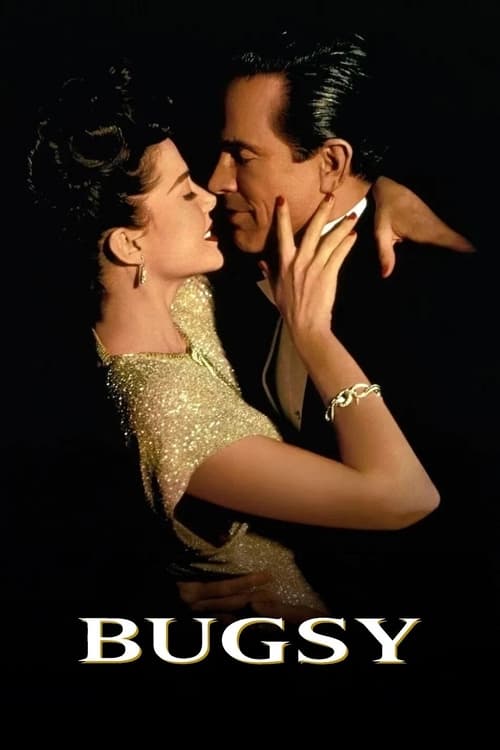
Bugsy (1991)
Directed by Barry Levinson
No · Ultra Based
How we score movies →Consciousness Markers
While Annette Bening's Virginia Hill is more independent than typical gangster-film love interests, she still exists primarily to support the male protagonist's arc rather than to critique patriarchal power dynamics.
The cast is uniformly white and male-dominated, with no meaningful demographic diversity. This reflects the historical period but shows no attempt at contemporary representation or casting consciousness.
There are no LGBTQ+ characters, themes, or representation in the film. The narrative is entirely heteronormative.
The film contains no engagement with racial themes, racial justice, or any acknowledgment of racial dynamics. It is a story of white organized crime told from within an entirely white perspective.
Climate or environmental themes are entirely absent from this gangster biography.
The film presents capitalism and wealth accumulation as thrilling and aspirational rather than critically examining them. Criminal enterprise is portrayed as glamorous rather than as a critique of economic systems.
There is no engagement with body positivity or body diversity. The film reflects conventional 1990s beauty standards without commentary.
Neurodivergence is not represented or discussed in the film.
The film presents its historical subject matter in conventional ways without revisionist reexamination of historical narratives or power structures.
The film does not interrupt its narrative to deliver political or social messages. It is a conventional crime drama focused on entertainment rather than preachy content.


Synopsis
New York gangster Ben 'Bugsy' Siegel takes a brief business trip to Los Angeles. A sharp-dressing womanizer with a foul temper, Siegel doesn't hesitate to kill or maim anyone crossing him. In L.A. the life, the movies, and most of all strong-willed Virginia Hill detain him while his family wait back home. Then a trip to a run-down gambling joint at a spot in the desert known as Las Vegas gives him his big idea.
Why it received this score
Bugsy is a 1991 period crime drama that, in its depiction of mid-century American masculinity and power, exhibits almost none of the markers we would associate with contemporary progressive cultural sensibilities. The film centers entirely on the masculine world of organized crime, with women functioning primarily as ornaments or obstacles to male ambition. Annette Bening's Virginia Hill, though given more agency than the typical gangster-film love interest, still exists principally to facilitate the male protagonist's narrative arc. The production design is meticulous and aesthetically accomplished, but this serves only to glamorize the criminal enterprise and the era's unreconstructed social attitudes.
The casting is notably homogeneous by contemporary standards, reflecting both the historical period and the film's lack of interest in demographic representation. There is no engagement whatsoever with racial consciousness, LGBTQ+ representation, feminist critique, or any other marker of modern progressive filmmaking. The film treats its subject matter as a thrilling power fantasy, complete with stylized violence and romantic intrigue, instead of as an opportunity for social commentary or critical examination. Bugsy remains a handsome, thoroughly conventional masculine power fantasy dressed in 1990s production values.
The film stands as an artifact of pre-2010s filmmaking sensibilities, a moment when Hollywood could still produce prestige crime dramas without feeling obligated to interrogate their own ideological assumptions. Its ten Academy Award nominations and single win for Art Direction confirm its status as a technically accomplished work of its era, one entirely untouched by the cultural consciousness that would come to define prestige filmmaking in subsequent decades.
Analysis generated by our Consciousness Algorithm
Critic Reviews
“He’s a real smoothie, Warren Beatty, and when he plays one in a movie he is almost always effective. But his title role in Bugsy is more than effective, it’s perfect for him - showing a man who not only creates a seductive vision, but falls in love with it himself.”
“A great gangster picture, with all the visceral excitement of a classic mob saga. But that's just its jumping-off point. It's also a salute to old Hollywood glamour, to the genre and the movies in general, and an elegant eulogy for the passing of those glory days. It's darned near perfect: violent, sexy and knowingly smart.”
“Bugsy is a gangster film around the edges, a '40s love song down the middle, and the year's breeziest live-actor movie through and through. [13 Dec 1991, p.1D]”
“One wishes Beatty would stay out of the epic business, but in that poor man's defense, he's become too large, too much of an icon on the screen to do much else. Perhaps he's doomed to play cartoon characters as he did last time out in Dick Tracy. His Bugsy is not anything close to a fully realized character. Bening, as his starlet/moll, does a better job, but her role doesn't give her much to work with.”