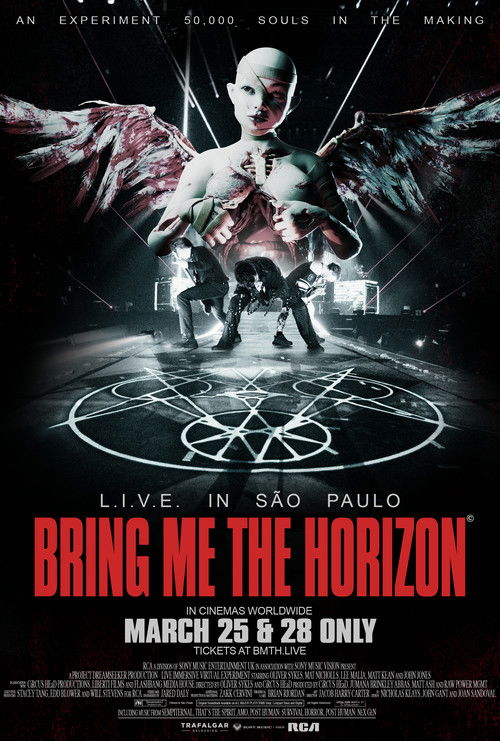
Bring Me the Horizon: L.I.V.E. in São Paulo (Live Immersive Virtual Experiment) (2026)
Directed by Oliver Sykes
No · Based
How we score movies →Consciousness Markers
Oli Sykes' personal veganism and commitment to sustainable fashion through Drop Dead Clothing suggest environmental consciousness at the biographical level. The film itself does not explicitly address climate themes, but the band's ethos carries this commitment implicitly.
The band itself is predominantly white and male, though the performance draws a diverse crowd. The film includes fan perspectives and participant submissions, lending some implicit diversity to the viewing experience without active representation in the band's composition or narrative focus.
The concert film operates primarily in the register of sensory experience and emotional catharsis rather than didactic messaging. The character cameos and narrative elements suggest thematic depth without delivering explicit instruction or ideological commentary.
While Oli Sykes operates vegan and ethical business ventures, this concert film is fundamentally a commercial product designed for theatrical release. The POST HUMAN album explores technological dystopia and social fragmentation but the film remains a celebration of consumption and spectacle.
The concert footage shows bodies of various shapes and ages enjoying music together. No explicit body positivity messaging is present, but the implicit celebration of bodily movement and pleasure in a non-judgmental space carries minor resonance with these themes.
The concert takes place in São Paulo before a diverse audience, and the film incorporates fan perspectives from multiple backgrounds. However, the film does not explicitly engage with racial themes or consciousness, and the band's lineup remains predominantly white.
No explicit LGBTQ+ themes or representation are evident in the concert film. The band's music and live performance do not address sexual or gender identity as thematic material, though the band has not been publicly hostile to such themes.
The film contains no identifiable feminist messaging or critique. While the band's music addresses contemporary concerns, the concert format does not foreground gender politics or feminist consciousness in any meaningful way.
The film spans the band's musical evolution across multiple albums and eras but makes no attempt to reinterpret history or challenge established narratives. It is a straightforward chronological celebration of the band's catalogue.
No representation of or engagement with neurodivergence is evident in the concert film. The performance and visual presentation do not address disability, neurodiversity, or mental health in ways that would register as active advocacy or representation.
Synopsis
The band's biggest headline show to date at São Paulo's Allianz Parque Stadium, performing to a sold-out crowd of 50,000. Hailed by the band as their best show yet, the film expands the visual universe of POST HUMAN, blending cinematic production, fan perspectives and character cameos such as E.V.E, Selene & M8. Featuring multi-camera footage, drone shots and fan-submitted footage, it delivers an immersive, multi-angle experience that mirrors the energy of the night. The performance spans the full evolution of BMTH's catalogue, from Sempiternal and That's the Spirit to amo and the POST HUMAN series.
Why it received this score
Bring Me the Horizon's concert film arrives as a peculiar artifact of contemporary rock stardom, a document that carries within it the faint residue of its creators' progressive commitments without quite knowing what to do with them. The band and its frontman Oli Sykes have cultivated a reputation for activism spanning veganism, sustainable fashion through Drop Dead Clothing, and lyrical engagement with post-pandemic anxiety and technological dystopia. None of this translates with any particular force into the film itself, which is fundamentally a celebration of spectacle, fan devotion, and the visceral experience of live music. The cinematic ambition, while evident in the multi-angle presentation and drone footage, remains subordinate to the primary purpose: capturing the energy of 50,000 people experiencing their favorite songs in real time.
The POST HUMAN album series, upon which much of this performance draws, does engage with contemporary themes of mental health, digital alienation, and social fragmentation, yet a concert film cannot examine these ideas with any depth. We get the aesthetic gestures toward progressive sensibility, the character cameos E.V.E, Selene, and M8 suggest narrative complexity that the live setting dissolves, but the format itself resists the kind of ideological work that would register meaningfully on our assessment. A band's vegan restaurant and ethical clothing line remain offscreen, their politics confined to the biographical margins while the film occupies itself with what it does best: the raw documentation of sonic and visual stimulation.
What we have, then, is a text suspended between its creators' stated values and the inherent conservatism of the concert film as a form. The audience is diverse by virtue of the band's global popularity, the performance spans different eras of the band's sound, and there is nothing objectionable in the proceedings. Yet none of this constitutes the specific markers we track. This is a film about a band that believes in progressive things, not a film that actively communicates those beliefs as part of its artistic statement. It is, in other words, exactly what you would expect from a major rock band in 2026 that has cultivated a progressive image: thoroughly professional, visually arresting, and content to let its social consciousness remain comfortably implicit.
Analysis generated by our Consciousness Algorithm