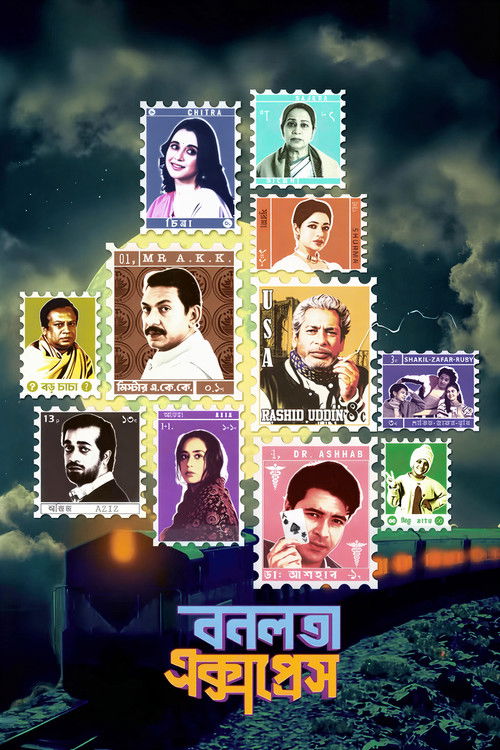
Bonolota Express (2026)
Directed by Tanim Noor
No · Ultra Based
How we score movies →Consciousness Markers
The film's social commentary on moral decay and political crisis carries a degree of earnest moral weight. However, the ensemble drama format channels this through character revelation rather than direct address, keeping the sermonizing quotient modest.
Themes of moral decay and systemic social dysfunction gesture toward a critique of the conditions that produce such decay. The gesture is mild and humanistic in register, stopping well short of modern anti-capitalist sermonizing.
The film features an all-Bangladeshi ensemble cast drawn from Dhallywood's established talent pool. This reflects the natural composition of a story set in Bangladesh, not a conscious act of identity-forward casting.
No LGBTQ+ themes, characters, or subplots have been identified in any available source material or critical coverage.
Several women appear in the ensemble, but the narrative framework, a classical confined-space drama of colliding secrets, gives no indication that feminist agenda is among the film's organizing concerns.
The film operates entirely within a Bangladeshi cultural context with no racial consciousness framing in the contemporary progressive sense.
A train journey through foggy winter countryside provides the setting, but there is no evidence the film treats this as an occasion for environmental commentary.
No evidence of body positivity themes or messaging in any available source.
No neurodivergent characters or related themes have been identified.
Adapted from a Humayun Ahmed novel, the film is concerned with human drama in a contemporary setting, not the reframing of historical narratives.
Synopsis
On a foggy winter journey, the Bonolota Express carries strangers burdened by secrets whose lives begin to collide within the train's confined corridors. As the night unfolds, personal and political crises erupt, exposing hidden grief, moral decay, and moments of unexpected compassion amid chaos and revolt. By dawn, the train moves on, leaving its passengers irrevocably changed by a single journey where illusions collapse and human truths emerge.
Why it received this score
Tanim Noor's "Bonolota Express" arrives as an adaptation of Humayun Ahmed's novel, dressed in the respectable garments of the ensemble train drama, a format so reliably suited to social observation that it practically scores itself. Strangers board, secrets collide, moral decay is exposed, and by dawn everyone is irrevocably changed. The train, as a setting, does a great deal of the thematic work simply by existing. Noor, a filmmaker with sixteen years of Dhallywood experience and a reputation for psychological precision, deploys his large cast, including Mosharraf Karim, Chanchal Chowdhury, and Zakia Bari Mamo, with the confidence of someone who has earned the right to stuff this many actors into a single corridor.
The film's social consciousness is of the classical South Asian humanist variety: it is interested in grief, in the gap between public face and private failure, in the small dignities people extend to one another when institutions have stopped bothering. This is not the social consciousness of a studio diversity committee. It is the social consciousness of a writer, Ahmed, who spent decades mapping the interior lives of ordinary Bangladeshis with the seriousness of a cartographer working a coastline that keeps shifting. The film earns its "moral decay" rhetoric through character, not through speeches delivered at the audience like subpoenas.
Released for Eid-ul-Fitr 2026 and promptly crossing the Tk3 crore threshold, "Bonolota Express" is, above all else, a film that Bangladeshi audiences wanted to see. The progressive sensibility here is pre-ideological: it believes in human complexity and the occasional, hard-won moment of compassion. A faint undercurrent of systemic critique surfaces in the film's portrait of decay, but it dissolves quickly into something warmer and considerably less programmatic. The train moves on. So does the film.
Analysis generated by our Consciousness Algorithm