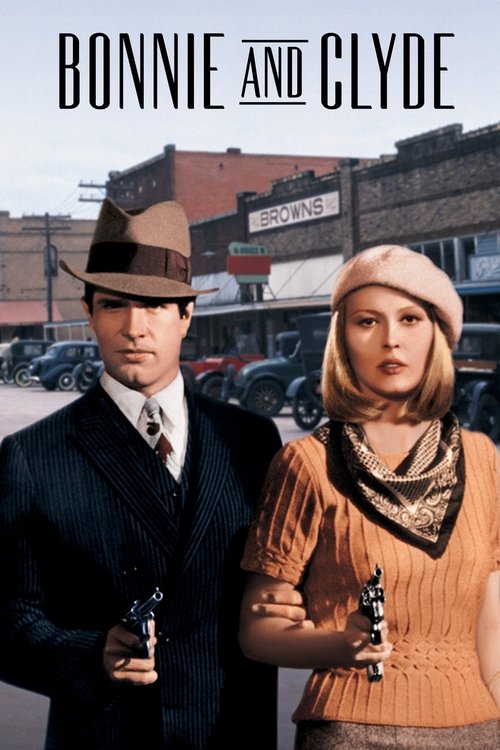
Bonnie and Clyde (1967)
Directed by Arthur Penn
No · Ultra Based
How we score movies →Consciousness Markers
The film depicts bank robbery and rebellion against authority, which resonated with anti-establishment youth of 1967. However, this represents general counterculture alienation rather than systematic critique of capitalism or class structures.
Bonnie Parker has agency and desire as a character, which was somewhat progressive for 1967, but the film does not interrogate gender systems or power dynamics. Her role remains within romantic-outlaw narrative conventions.
The film presents a romanticized, sympathetic portrayal of real historical criminals, which could be considered revisionist. However, this is narrative reframing rather than modern progressive historical revisionism.
The film communicates its themes through narrative and visual storytelling rather than explicit exposition or preachy messaging. Minimal lecture energy by any standard, though the anti-establishment sentiment is present.
All white cast in period crime drama with no apparent consideration of representation or diversity in casting decisions. This reflects 1967 Hollywood norms rather than any contemporary consciousness.
Set in 1930s America with no acknowledgment of race, segregation, or racial dynamics of the era. The film shows no racial consciousness by modern standards.
No LGBTQ+ themes, representation, or subtext present in the film. Heterosexual romance is the central relationship.
No climate-related themes, messaging, or environmental consciousness present in this crime film.
No body positivity messaging or representation of diverse body types. Conventional 1960s Hollywood aesthetic standards apply throughout.
No representation of neurodivergent characters or themes related to disability, mental health, or neurodiversity.


Synopsis
In the 1930s, bored European-American waitress Bonnie Parker falls in love with a European-American ex-con named Clyde Barrow and together they start a violent crime spree through the country, stealing cars and robbing banks.
Why it received this score
Arthur Penn's "Bonnie and Clyde" arrived in 1967 as a transgressive object, celebrated by critics and youth audiences for its frank depiction of violence and its sympathetic treatment of criminals. The film was indeed progressive by the standards of its era, challenging Hollywood's moral conventions and offering audiences a female protagonist with genuine agency and desire. However, this remains fundamentally a 1960s counterculture artifact, not a 2020s progressive text. The film's anti-establishment posture was born of general youth alienation and anti-war sentiment, not from the specific constellation of social justice frameworks that would later coalesce into recognizable modern progressive identity politics.
The cast consists entirely of white actors playing white characters, a fact neither interrogated nor celebrated by the film itself. Bonnie Parker emerges as a complex character, certainly, but her complexity exists in the service of a romantic-outlaw narrative rather than in explicit interrogation of gender roles or systemic inequality. The film's violence, shocking at the time, functions as spectacle and as commentary on American mythology rather than as critique of systemic oppression or examination of intersectional power dynamics.
We must distinguish between a film that was culturally disruptive in 1967 and one that exhibits the specific markers of contemporary progressive consciousness. "Bonnie and Clyde" belongs to the former category entirely. It was ahead of its time in certain aesthetic and narrative choices, but it preceded by decades the particular social consciousness metrics we now use to evaluate cultural texts. The film remains a landmark achievement in cinema history, but it does not register meaningfully on any scale designed to measure 2020s-era progressive sensibility.
Analysis generated by our Consciousness Algorithm
Critic Reviews
“So definitive in so many ways, Bonnie and Clyde has become a 20th-century touchstone.”
“Bonnie and Clyde is a milestone in the history of American movies, a work of truth and brilliance. It is also pitilessly cruel, filled with sympathy, nauseating, funny, heartbreaking, and astonishingly beautiful.”
“There is something special about the production, with its brash, vivid style, indelible performances by movie icons, and bold mixture of violence and comedy, romance and tragedy.”
“Director Arthur Penn have elected to tell their tale of bullets and blood in a strange and purposeless mingling of fact and claptrap that teeters uneasily on the brink of burlesque. Like Bonnie and Clyde themselves, the film rides off'in all directions and ends up full of holes...The real fault with Bonnie and Clyde is its sheer, tasteless aimlessness.”