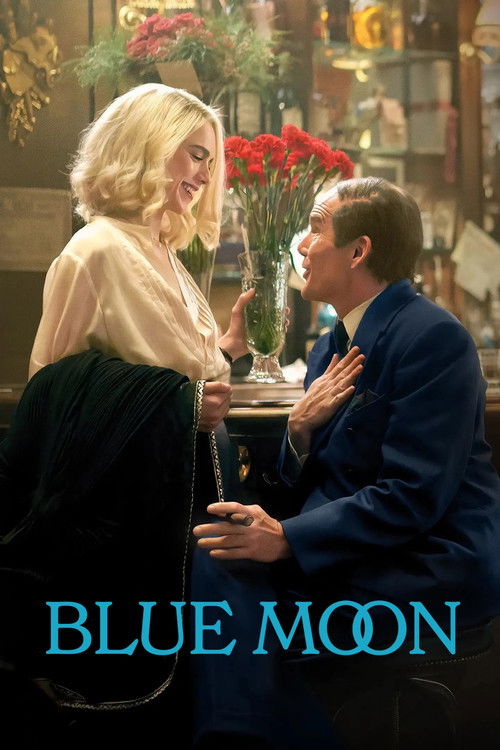
Blue Moon (2025)
Directed by Richard Linklater
No · Ultra Based
How we score movies →Consciousness Markers
The film centers on a closeted gay man and his personal anguish, with Andrew Scott in the cast suggesting awareness of the subject. However, Hart's sexuality appears treated as one element of his suffering rather than a focal point for contemporary LGBTQ+ consciousness or political messaging.
The film depicts professional competition and artistic commodification within Broadway capitalism, but these are treated as backdrop to personal drama rather than systemic critique.
The film is a historical drama set in 1943 that appears to respect historical accuracy rather than revise it. Minor score for depicting a historical figure with psychological depth.
No evidence of intentional casting for diversity or representation purposes. The cast appears cast for talent and Linklater's collaborative relationships.
No evidence of feminist themes or critique. The film is centered on a male protagonist's professional decline and personal crisis.
No indication of racial themes or racial consciousness in a film set on a single night in a Broadway bar in 1943.
No environmental or climate-related themes present in a historical character study set in an indoor bar.
No evidence of body positivity themes or commentary in the film.
While Hart's depression and alcoholism could be read as mental health themes, there is no indication these are framed through a neurodivergence lens rather than as character pathology.
No indication of preachy or preachy elements. Linklater's style is observational and subtle rather than moralistic.


Synopsis
On the evening of March 31, 1943, legendary lyricist Lorenz Hart confronts his shattered self-confidence in Sardi's bar as his former collaborator, Richard Rodgers, celebrates the opening night of his ground-breaking hit musical, "Oklahoma!"
Why it received this score
Richard Linklater's "Blue Moon" is a portrait of artistic and personal disintegration rendered with the precision of a medical examiner documenting a familiar case. Ethan Hawke's Lorenz Hart sits in Sardi's bar on March 31, 1943, watching his former collaborator Richard Rodgers ascend to glory with "Oklahoma," a show that Hart had no part in creating. The film moves through Hart's evening like a man checking items off a list: bitterness, nostalgia, self-pity, the occasional glimmer of the wit that once defined him. Linklater treats Hart's decline with a kind of anthropological distance, observing rather than judging, which is to say he observes without sentimentality.
The film's engagement with Hart's sexuality remains largely subterranean. Hart was a closeted gay man whose personal life was a source of considerable pain, and the film acknowledges this through implication and the weight of unsaid things rather than explicit statement. Andrew Scott's presence in the cast suggests the film is not unaware of this dimension, yet it does not mobilize Hart's queerness as a platform for contemporary commentary. Instead, the film treats it as one thread among many in the tapestry of Hart's unhappiness, which included professional anxiety, alcoholism, and the simple fact of being left behind by history. This is a film about a man confronting obsolescence on a specific night, not a film about systemic injustice or the need for cultural reckoning.
What emerges from Linklater's approach is a work of historical drama that respects its subject without attempting to retrofit him into contemporary ideological frameworks. Hart remains Hart, trapped in his moment, speaking in the cadences and assumptions of his time. The film's cultural consciousness extends only so far as acknowledging that Hart suffered, that his suffering was real, and that his talent deserved better than to be discarded. This is the humanist position, not the progressive one. It is sufficient unto itself.
Analysis generated by our Consciousness Algorithm
Critic Reviews
“A warm and pleasant romantic fantasy that shows BenGazzara and Rita Moreno to advantage but is better suited to the tube or the stage.”
“Although the odds are against them, Mr. Gazzara and Ms. Moreno succeed in cutting through the forced sitcom banter to create a credible and touching portrait of a marriage of two proud individuals who respect each other even in moments of strife.”