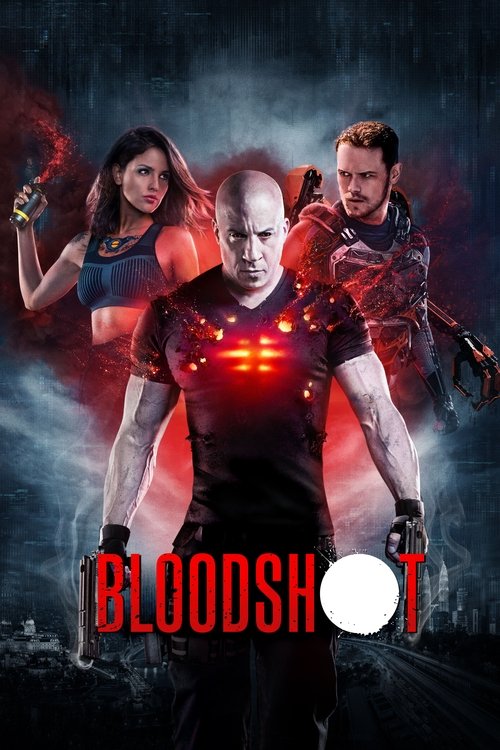
Bloodshot (2020)
Directed by Dave Wilson
No · Ultra Based
How we score movies →Consciousness Markers
The cast includes Eiza González in a supporting role and Lamorne Morris as a fellow soldier, providing some ethnic diversity. However, the lead remains a white male action hero, and the female characters are largely sidelined in a traditional revenge narrative.
While the cast includes actors of color, there is no explicit racial consciousness or commentary in the narrative. The diverse casting appears incidental rather than thematic or intentional.
The film touches on military-industrial conspiracy and corporate malfeasance as part of its plot mechanics, but these elements serve the revenge narrative rather than offering systemic critique.
No LGBTQ+ themes, characters, or representation are present in the film. The narrative centers entirely on heterosexual relationships and male-dominated action sequences.
The film contains no feminist agenda or commentary. The protagonist's wife exists primarily as motivation for the male hero's revenge plot rather than as a developed character with agency.
No climate-related themes or environmental consciousness are present in this military revenge thriller.
The film presents no body positivity messaging. The protagonist is depicted as an idealized muscular action hero, and no alternative body types or positive representation of diverse physicality appear.
No neurodivergent characters or themes are present. The narrative does not engage with disability, mental health, or neurodiversity.
This is a fictional superhero narrative with no historical content or revisionist elements. It makes no claims about real historical events.
The film does not engage in preachy social commentary or lecture the audience about social issues. It is a straightforward action-revenge narrative.


Synopsis
After he and his wife are murdered, marine Ray Garrison is resurrected by a team of scientists. Enhanced with nanotechnology, he becomes a superhuman, biotech killing machine—'Bloodshot'. As Ray first trains with fellow super-soldiers, he cannot recall anything from his former life. But when his memories flood back and he remembers the man that killed both him and his wife, he breaks out of the facility to get revenge, only to discover that there's more to the conspiracy than he thought.
Why it received this score
Bloodshot arrives as a straightforward action vehicle designed with surgical precision to deliver exactly what the title promises: spectacle without substance. The film concerns itself with nanotechnology, memory manipulation, and corporate conspiracy, yet none of these elements function as vehicles for cultural commentary. Ray Garrison's resurrection and subsequent quest for vengeance follows the most traditional of Hollywood formulas, with his wife's death serving as narrative fuel rather than opportunity for anything resembling thematic complexity. The diverse casting, while present, operates as window dressing rather than meaningful representation, with supporting characters of color performing their designated roles without challenging the film's fundamental conservatism.
What emerges from the narrative is a film entirely uninterested in interrogating its own premises. The military-industrial conspiracy that drives the plot exists purely as plot mechanics, not as social critique. The female characters remain peripheral to the central action, their presence acknowledged but their agency severely circumscribed. Even the film's exploration of consciousness and memory, potentially rich thematic territory, remains superficial, deployed only to justify the protagonist's emotional arc and combat sequences. The film is competently assembled, technically proficient, and utterly devoid of anything resembling progressive sensibility or cultural awareness.
The score reflects a film that exists in a fundamentally pre-2015 ideological space, updated only with contemporary action cinematography and visual effects. No marker of modern progressive consciousness penetrates its surface. Bloodshot operates as an artifact of pure entertainment machinery, neither offensive nor engaged, a product designed to be consumed and forgotten without leaving any cultural residue whatsoever.
Analysis generated by our Consciousness Algorithm
Critic Reviews
“Bloodshot is a trash compactor of a comic-book film, but it’s smart trash, an action matrix that’s fun to plug into.”
“So much of the movies is the right kind of entertaining, with the right kind of actors playing the right kind of second-tier blockbuster roles, that Bloodshot cannot help but be a cult classic in the making. This is Hollywood escapism at its finest at a time when we need it the most. ”
“Bloodshot runs out of meta tricks before it is over, and David S.F. Wilson, who borrows his visual vocabulary from Tony Scott and Michael Bay, delivers action sequences with such choppy continuity that viewers may be as confused as Ray. He deserves bonus points, however, for embracing silliness.”
“The superhero film equivalent of the worst kid at the playground. ”