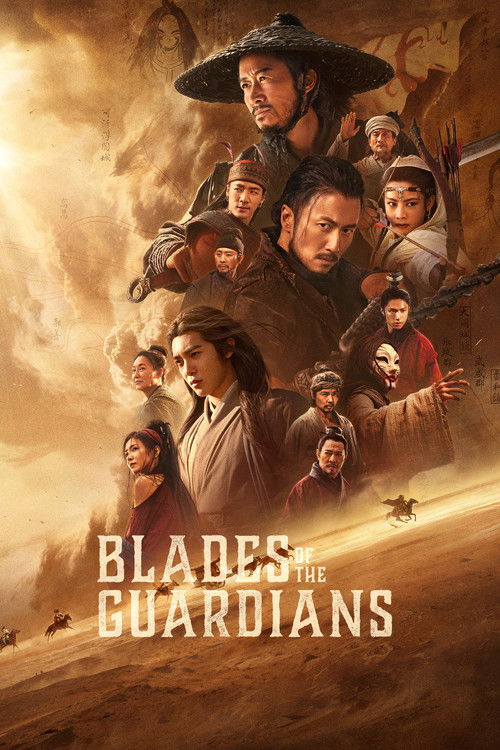
Blades of the Guardians: Wind Rises in the Desert (2026)
Directed by Yuen Woo-Ping
No · Ultra Based
How we score movies →Consciousness Markers
The film depicts a world of bounty hunters and fugitives, which could be read as engaging with themes of economic survival, though this appears incidental to the action narrative rather than intentional critique.
The film is set in ancient China but appears to embrace wuxia genre conventions rather than to interrogate or revise historical narratives. Any historical elements serve the adventure plot.
Female cast members are present (Kara Hui Ying-Hung) but appear to occupy supporting roles in a male-centered action narrative. No apparent feminist agenda or gender-conscious messaging.
Critical reception emphasizes action choreography and narrative pacing rather than thematic lectures. The film appears to trust its audience to engage with moral questions through action rather than exposition.
The film features an all-Asian cast in an Asian setting, which reflects demographic reality rather than conscious representation politics. No apparent effort to diversify beyond the cultural context of the source material.
No evidence of LGBTQ+ themes, representation, or subtext in this traditional wuxia action film. The narrative focuses entirely on martial conflict and honor codes.
As a Chinese historical martial arts film set in ancient China, racial consciousness as a modern analytical framework does not appear to factor into the film's thematic concerns.
No evidence of climate-related messaging or environmental consciousness. The desert setting is deployed as a narrative backdrop rather than as ecological commentary.
The film emphasizes martial prowess and physical performance rather than body positivity messaging. Yuen's focus on 'the beauty of strength' reflects aesthetic rather than social justice concerns.
No apparent representation of or commentary on neurodivergence in this traditional action film focused on combat choreography.
Synopsis
Dao Ma, the "second most wanted fugitive," is entrusted by his benefactor, the chief of Mo family clan, to take on a mysterious escort mission-escorting the "most wanted fugitive" to Chang'an.
Why it received this score
Yuen Woo-Ping's return to the wuxia tradition demonstrates the tenacity of a now-octogenarian director who refuses to let the genre become a museum piece. "Blades of the Guardians" is an adaptation of a manhua that privileges physical poetry over philosophical posturing, presenting a world where moral ambiguity exists independent of any particular social framework. The film concerns itself with the interior architectures of loyalty, obligation, and honor as they manifest in concrete action sequences rather than in dialogue designed to educate audiences about systemic inequities.
The narrative revolves around fugitives and bounty hunters in an ancient desert setting, which is to say it operates within the established conventions of wuxia cinema without apparent interest in reframing those conventions through contemporary cultural preoccupations. Wu Jing's protagonist is a "good-hearted" criminal, a characterization that emerges through behavior rather than through speeches about redemption or systemic injustice. The film appears content to explore the moral dimensions of its universe without reference to how that universe might reflect upon modern social consciousness.
What emerges from the available critical reception is admiration for Yuen's commitment to what he terms "the beauty of strength," a phrase that gestures toward aesthetic rather than political concerns. The film opened modestly in limited release, suggesting it occupies a niche position within contemporary cinema. This is a work of genre cinema that seems blissfully uninterested in the cultural anxieties that animate much of contemporary filmmaking, which is either its greatest strength or its most notable limitation depending on one's disposition toward such matters.
Analysis generated by our Consciousness Algorithm
Critic Reviews
“Loaded with intense action, amazing choreographed fights and stunts, and great sound and editing the film is a wonderful achievement. To the delight of many the result is we have the first great film of 2026.”
“Adapted from Xianzhe Xu's acclaimed comic series, Blades of the Guardians is a modern wuxia classic, filled with sweeping desert vistas, an intricate storyline, and, as you'd expect, blinding martial arts action.”
“As one of the most anticipated Chinese New Year blockbusters of 2026, Blades of the Guardians — fully titled Blades of the Guardians: Wind Rises in the Desert on-screen — has a lot going for it.”
“Yuen Woo-ping returns to directing with Blades of the Guardians, a wuxia action film starring Wu Jing and Jet Li. Read our review of this 2026 martial arts epic.”