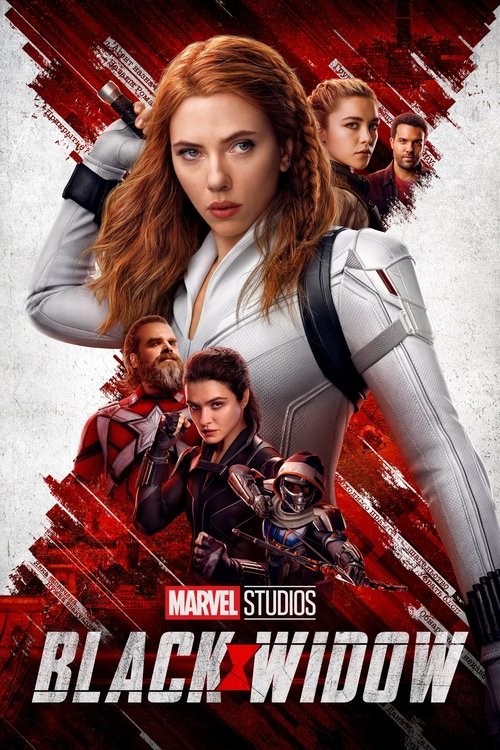
Black Widow (2021)
Directed by Cate Shortland
Partly · Woke-Adjacent
How we score movies →Consciousness Markers
Female director Cate Shortland helms the film with a predominantly female cast. The villain Taskmaster is reimagined as female, though this represents character adaptation rather than groundbreaking representation.
Strong emphasis on female agency, sisterhood between Natasha and Yelena, and critique of patriarchal violence. Research suggests the original vision was more explicitly feminist before being 'sanitized.'
The film includes some explicit discussion of trafficking and feminist themes but generally allows character dynamics and action to carry meaning rather than delivering overt ideological lectures.
The cast is predominantly white with minimal racial consciousness. O-T Fagbenle appears in a supporting role but racial themes are not central to the narrative.
The villain operates a human trafficking organization, but this is treated as personal villainy rather than systemic or capitalist critique.
No LGBTQ+ themes, representation, or subtext are present in the film.
No climate themes or environmental consciousness are present in the film.
No body positivity themes or commentary regarding diverse body representation are evident.
No neurodivergence representation or themes are present in the narrative.
While Taskmaster is reimagined as female, this is character adaptation within a fictional narrative rather than historical revisionism.


Synopsis
Natasha Romanoff, also known as Black Widow, confronts the darker parts of her ledger when a dangerous conspiracy with ties to her past arises. Pursued by a force that will stop at nothing to bring her down, Natasha must deal with her history as a spy and the broken relationships left in her wake long before she became an Avenger.
Why it received this score
Black Widow represents the contemporary blockbuster's cautious approach to progressive sensibilities, deploying female representation and feminist themes with the strategic precision of a marketing department that has attended exactly one seminar on gender politics. Director Cate Shortland brings her art house sensibilities to the Marvel apparatus, centering a film on female agency, sisterhood, and the consequences of patriarchal violence, yet the result feels neutered compared to what critical discourse suggests was the original vision. The film's most interesting element is its insistence on female characters as agents of their own narratives rather than ornaments to male heroics, though this remains comfortably within the boundaries of what a corporation worth hundreds of billions of dollars finds acceptable to distribute.
The cast is predominantly female, the action sequences are competently staged, and there are moments when the film gestures toward genuine feminist inquiry about trauma, autonomy, and the systems that exploit women. Florence Pugh's Yelena provides some of the film's most genuine emotional weight, and the reimagining of Taskmaster as a female character, while narratively convenient, at least distributes agency across gender lines. Yet the film ultimately settles for representation without revolution, content to celebrate that women can throw punches and lead franchises without interrogating the larger structures that necessitate such violence in the first place.
Black Widow is a film comfortable existing in the cultural mainstream, neither challenging nor alienating its broad audience. It understands the vocabulary of progressive cinema without necessarily speaking the language. The box office success, opening to $80 million domestically, suggests audiences were eager for this particular calibration of feminist themes wrapped in spectacular action and familiar Marvel plotting. Whether one finds this approach admirably pragmatic or hollow likely depends on tolerance for corporate progressive aesthetics.
Analysis generated by our Consciousness Algorithm
Critic Reviews
“Shortland has given us a fast-paced movie with action sequences, character depth, and very subtle social and political subtexts about the way women are seen, treated and exploited in the world. ”
“Black Widow is mostly an entertaining and adequate tribute to Natasha Romanoff, Black Widow, and Scarlett Johannson’s time in the Marvel Cinematic Universe. Still, it’s not quite the bittersweet, moving, or resonant send-off one might have hoped for based on the initial movie’s promise of exploring a dark and damaged past and what that does to the soul.”
“As a reintroduction to the cinematic universe after a year off due to the COVID-19 pandemic, it’s definitely worth a look. Here’s hoping more Marvel flicks take inspiration from this one: shrink their scope, focus on the characters, and get the action right. And for God’s sakes, give us better third acts.”
“Black Widow is what happens when movies abandon human values for the emotional deadness and emptiness of the superhero movie. ”