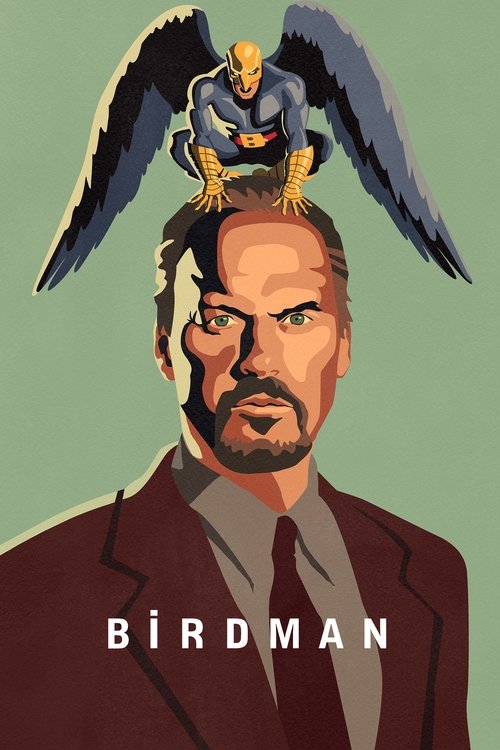
Birdman or (The Unexpected Virtue of Ignorance) (2014)
Directed by Alejandro González Iñárritu
No · Ultra Based
How we score movies →Consciousness Markers
The film satirizes the entertainment industry and celebrity culture, including commentary on commercial success versus artistic integrity. However, this critique is more about industry concerns than systemic anti-capitalist ideology.
Emma Stone's character has some agency as Riggan's daughter, but female characters generally exist in subordinate roles to the male lead's narrative arc. The film does not engage with feminist themes.
The ensemble cast includes women in notable roles, but they are largely defined through their relationships to the male protagonist. No particular effort toward diverse or purposeful representation beyond standard casting.
The film is primarily character-driven with existential themes. Some of Michael Keaton's monologues about meaning and legacy carry slight preachy undertones, but the film is not preachy overall.
No LGBTQ+ themes, characters, or content present in the film.
The film shows no engagement with racial themes or racial consciousness. The cast is predominantly white, and there is no commentary or awareness of this.
No climate or environmental themes present in the film.
No body positivity messaging or engagement with body image issues.
While Riggan exhibits obsessive and unstable behavior, this is not framed as neurodivergence or explored with that lens.
The film contains no historical content or revisionist elements.


Synopsis
A fading actor best known for his portrayal of a popular superhero attempts to mount a comeback by appearing in a Broadway play. As opening night approaches, his attempts to become more altruistic, rebuild his career, and reconnect with friends and family prove more difficult than expected.
Why it received this score
Birdman arrives as a virtuoso exercise in cinematic technique, a film so preoccupied with its own formal ambitions that it barely glances at the cultural preoccupations of the moment. Michael Keaton's Riggan Thomson is an aging actor haunted by his past success, wrestling with questions of meaning and legacy in an industry that has moved on without him. The satire here cuts at celebrity culture and commercial entertainment, but it does so from within a fundamentally individualistic framework, concerned with personal ego rather than systemic critique.
The film's engagement with progressive sensibilities is minimal to nonexistent. Female characters exist primarily as satellites to Riggan's existential crisis, their own arcs subordinate to his journey. There is no racial consciousness, no climate awareness, no interrogation of the body or neurodivergence, no revisionist historical impulse. The entertainment industry critique, such as it is, amounts to a fairly conventional lament about the death of serious theater in the age of superhero franchises, a complaint that feels more nostalgic than progressive.
What remains is a masterfully constructed character study, all nervous energy and technical innovation, that reflects the concerns of 2014 cinema: artistic integrity, masculine relevance, and the terror of obsolescence. It is precisely what we might expect from a film more interested in how to tell its story than what social consciousness to embed within that story. The film won the Academy Award for Best Picture, a choice that speaks to the tastes of an institution not yet particularly attuned to the cultural reckoning that would follow.
Analysis generated by our Consciousness Algorithm
Critic Reviews
“Spectacular, star-powered cinema that makes us ask anew what cinema is for. Call it a "Dark Knight" of the soul. ”
“Birdman is a rich, startlingly clever and multi-layered collage, with Iñárritu creating a meta-universe of mirrors and performances upon performances.”
“The film's exhilarating originality, black comedy and tone that is at once empathetic and acidic will surely strike a strong chord with audiences looking for something fresh that will take them somewhere they haven't been before.”
“An unrecognizable Michael Keaton seems to have aged 40 years since the last time he appeared on the screen, but he’s still the best (i.e., only) reason to suffer through a miserable load of deranged, deluded crap masquerading as a black comedy called Birdman. ”