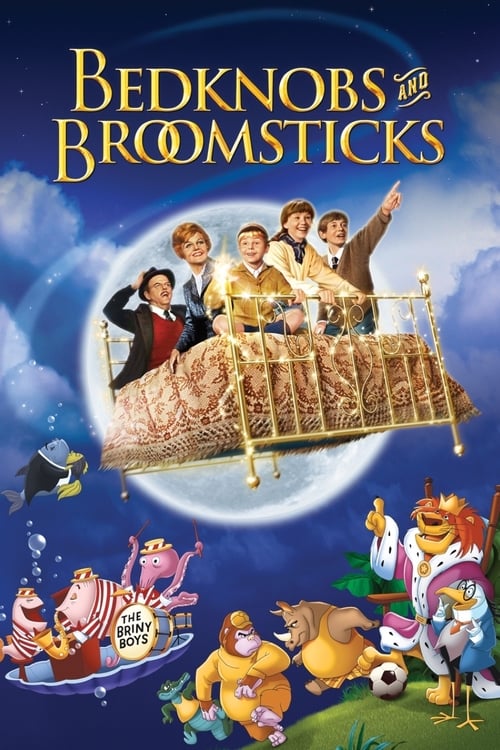
Bedknobs and Broomsticks (1971)
Directed by Robert Stevenson
No · Ultra Based
How we score movies →Consciousness Markers
Angela Lansbury plays an independent unmarried woman, but she is portrayed as an eccentric rather than as a conscious feminist figure. Her agency is presented as quirky rather than political.
The film's treatment of World War II as a magical-adventure backdrop represents a mild form of historical revision, sanitizing the conflict into family entertainment without engaging its actual horrors.
The cast is entirely white and European. While this reflects 1971 Hollywood norms, there is no meaningful representation of any marginalized group. The film makes no effort toward inclusive casting.
The film contains no anti-capitalist messaging. If anything, the characters' pursuit of magical knowledge and treasure is framed as an individual adventure rather than a critique of economic systems.
There are no LGBTQ+ themes, characters, or subtext present. The film is entirely heteronormative and makes no acknowledgment of sexual orientation or gender identity.
The film contains no racial consciousness, no discussion of race, and no engagement with racial issues. It is entirely a product of white British-American cinema.
Climate concerns are entirely absent from this fantasy adventure film. There is no environmental messaging or ecological awareness present.
There is no body positivity messaging. The film presents no commentary on physical appearance or body standards, positive or otherwise.
Neurodivergence is not addressed or represented. The film contains no depiction of autism, ADHD, dyslexia, or any neurological difference.
The film contains no preachy monologues or lecture-like dialogue designed to educate viewers about social issues. It is purely entertainment.


Synopsis
Three children evacuated from London during World War II are forced to stay with an eccentric spinster. The children's initial fears disappear when they find out she is in fact a trainee witch.
Why it received this score
Bedknobs and Broomsticks presents itself as a whimsical wartime fantasy, a film content to entertain children without troubling itself overmuch with the ideological commitments of its era or any subsequent one. It is, by any reasonable measure, a product of 1971 that has aged into something approaching a historical artifact. The film concerns itself with the adventures of evacuated children and their unlikely guardian, a woman devoted to amateur witchcraft and the pursuit of magical knowledge. There is nothing here that suggests the filmmakers were particularly invested in interrogating their own assumptions about gender, class, race, or the nature of power itself.
The presence of Angela Lansbury as an unmarried woman of independent means and intellectual pursuits represents perhaps the film's only tangential connection to progressive sensibility, though this is incidental rather than programmatic. She is not presented as a model of liberation so much as a harmless eccentric, a stock character type that predates modern progressive cinema by decades. The film's treatment of World War II functions as pure backdrop, a plot device to explain why children require temporary guardianship. There is no interrogation of the war itself, no engagement with its moral complexities, no examination of how trauma might affect the evacuees. The conflict simply exists as scenery.
This is a film uninterested in the social consciousness that would later define cinema in the 2020s. There are no meaningful discussions of systemic oppression, no celebration of diverse identities as such, no lectures delivered through character dialogue. The film is refreshingly innocent of the burden of contemporary sensibilities. It simply wants to show us dancing suits of armor and magical adventures. One respects, if nothing else, its singular lack of pretension to social relevance.
Analysis generated by our Consciousness Algorithm
Critic Reviews
“The script is tight and witty with sparks of sophistication. This is a film that, while never quite given the rightful place in the Disney canon it deserved, had a positive influence on many lives over the decades, including that of this writer.”
“Oscar-winning special effects and animation sequences by Ward Kimball make this musical fantasy a perennial favorite. ”
“The magic of Walt Disney lingers magnificently on in Bed knobs and Broomsticks.”
“Must all films for kids be so shoddy, though? The music is appalling.”