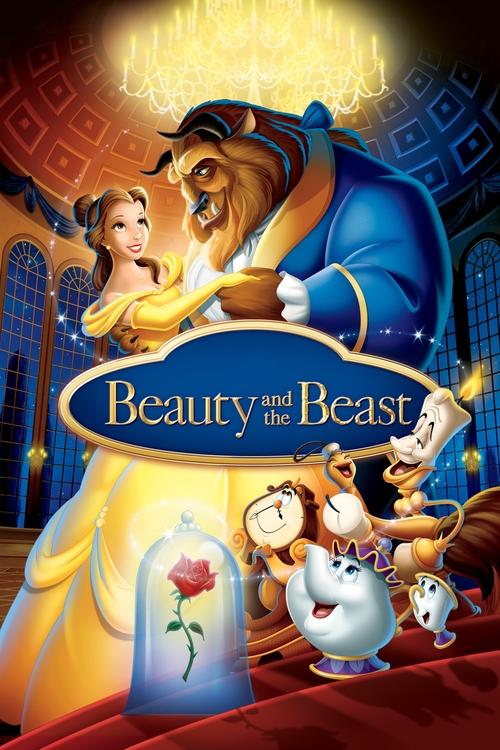
Beauty and the Beast (1991)
Directed by Gary Trousdale
No · Based
How we score movies →Consciousness Markers
Belle is bookish, independent-minded, and rejects conventional beauty standards and male attention, which was relatively progressive for 1991 Disney. However, her arc culminates in marriage and domesticity rather than autonomous fulfillment.
The central message that beauty comes from within suggests acceptance of non-conventional appearance, but the film still privileges Belle's conventional attractiveness and uses the Beast's appearance as his primary source of shame.
The film mildly critiques Gaston's materialism and physical vanity, but it ultimately endorses Belle's marriage to wealth and nobility rather than offering any systemic critique of class or capital.
While the film has a clear moral message about inner beauty, it presents this through song and narrative rather than through explicit preachy lecturing. The message is woven into the story.
The entire cast is white with no visible racial diversity among principals or supporting characters. This reflects 1991 animation industry norms rather than any intentional commitment to representation.
No LGBTQ+ themes, representation, or subtext are present in the film. All romantic and relational dynamics are heteronormative.
The film contains no engagement with racial themes, diversity, or racial consciousness. It is set in a timeless European fantasy world with an entirely white cast.
There are no environmental or climate-related themes in the film. The castle and forest setting serve purely narrative functions.
Belle's intellectual interests and social isolation are portrayed as character quirks rather than as neurodivergence. There is no representation of or engagement with neurodivergent experiences.
The film is a fantasy adaptation of a fairy tale and contains no historical claims or revisionist history. It exists in a timeless, fictional setting.


Synopsis
Follow the adventures of Belle, a bright young woman who finds herself in the castle of a prince who's been turned into a mysterious beast. With the help of the castle's enchanted staff, Belle soon learns the most important lesson of all -- that true beauty comes from within.
Why it received this score
Beauty and the Beast arrives as a curious artifact of the early 1990s, a moment when Disney was beginning to contemplate the concept of female agency without yet knowing what to do with it. Belle is presented as bookish and different from her provincial townspeople, a choice that reads now as a gentle proto-feminism, though the film never quite commits to the radical proposition of a woman pursuing intellectual fulfillment over romantic attachment. She rejects the advances of Gaston, the conventionally handsome suitor, which feels progressive for 1991 animation, yet her ultimate arc still culminates in marriage to a prince and domestic contentment. This is not progressive consciousness so much as it is the faintest gesture toward complexity.
The film's castle is staffed by enchanted objects whose voices and characterizations are uniformly white, a casting choice that reflects the animation industry's composition in 1991 rather than any intentional statement about representation. There is no racial diversity among the principal or secondary characters, no discussion of class beyond the most superficial contrasts between Belle's intellectual superiority and Gaston's physical brutishness. The supporting female characters exist primarily to facilitate Belle's narrative. Angela Lansbury's Mrs. Potts delivers maternal warmth but little agency of her own.
The film's central message, that "true beauty comes from within," functions as a moral rather than as social commentary. It is a humanist sentiment divorced from any engagement with modern identity politics, diversity initiatives, or contemporary progressive frameworks. We are meant to learn that appearances deceive and that kindness matters. This is good counsel for any era, but it is not what we now understand as progressive cultural consciousness. The film earns its modest score primarily through Belle's intellectual interests and refusal of traditional feminine expectations, choices that were genuinely countercultural for Disney in 1991, though they would scarcely register as noteworthy by contemporary standards.
Analysis generated by our Consciousness Algorithm
Critic Reviews
“Disney's 30th animated feature, Beauty and the Beast stands at the pinnacle of animated accomplishment, even when weighted against the excellencies of its lineage.”
“It is the most dynamic animated film ever made, and the prance of its camera, the sense of penetration into its action, the brilliantly paced editing pyrotechnics give it a crackle of life far more abundant than any feature that's come before.”
“Beauty and the Beast reaches back to an older and healthier Hollywood tradition in which the best writers, musicians and filmmakers are gathered for a project on the assumption that a family audience deserves great entertainment, too.”
“Beauty and the Beast, one of Disney's latest animated features is even better than The Little Mermaid. At the same time, it's vaguely disappointing.”