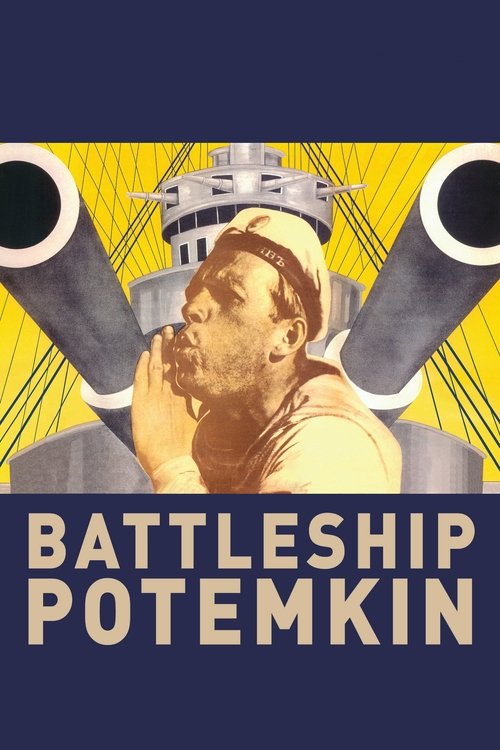
Battleship Potemkin (1925)
Directed by Sergei Eisenstein
No · Ultra Based
How we score movies →Consciousness Markers
The film is explicitly anti-capitalist in its ideological orientation, celebrating workers and condemning the state apparatus. However, this reflects Soviet revolutionary ideology rather than contemporary anti-capitalist progressive sensibility.
The film dramatizes and propagandizes historical events in service of Soviet revolutionary ideology, though this constitutes historical revisionism rather than contemporary progressive revisionism.
The film carries ideological conviction and preachy purpose, but the lecture emerges from Soviet communist ideology rather than contemporary progressive discourse.
Cast drawn from Soviet performers of the era with no consideration for contemporary representation principles. Casting appears entirely determined by availability and role requirements.
No LGBTQ+ themes, representation, or subtext present in the narrative. The film's focus is entirely on class revolution.
No feminist agenda discernible. Women appear minimally in the narrative, and gender is not a thematic concern of the film.
No racial consciousness or commentary present. The film depicts a specific historical Russian naval event with no engagement with racial themes.
No climate-related themes or crusade present. The film's concerns are entirely political and historical, not environmental.
No body positivity messaging or themes present. The film treats bodies instrumentally as elements of montage and collective action.
No representation of or engagement with neurodivergence. The concept would be anachronistic to the film's 1925 Soviet context.


Synopsis
A dramatized account of a great Russian naval mutiny and a resultant public demonstration, showing support, which brought on a police massacre.
Why it received this score
Sergei Eisenstein's 1925 revolutionary masterpiece documents the 1905 Potemkin mutiny with the fervent commitment of a man who believes he is filming the birth pangs of the new world. The film remains a towering achievement in cinematic language, particularly in its legendary Odessa Steps sequence, where montage becomes not merely a technique but an instrument of collective trauma. The work is undeniably political, but this is politics of the classical Soviet revolutionary stripe, not the cultural politics of contemporary progressivism.
The film presents working-class solidarity and the heroism of the mutineers with unironic earnestness. Eisenstein's montage celebrates the masses as an undifferentiated force, a collective body that moves with revolutionary purpose. Yet this is a film about class conflict and workers' liberation, concepts that predate modern social consciousness by decades. The sailors are heroes, the officers are tyrants, and the narrative thrust is straightforward and unambiguous. There is no interrogation of power dynamics, no self-consciousness about representation, no contemporary markers of progressive cultural sensibility.
The film's social consciousness operates on an entirely different register than the markers we assess. It is a work of historical importance and artistic genius, but it exhibits none of the specific cultural preoccupations that emerged in the 2020s. The sailors are men, the representation is incidental to the revolutionary narrative, there is no discussion of identity or diversity, and the film's lecture energy derives from Soviet ideological conviction rather than contemporary progressive discourse. We are observing a relic of an older political tradition, however artistically magnificent that relic may be.
Analysis generated by our Consciousness Algorithm
Critic Reviews
“If you are at all interested in the history of cinema, or the influence of 20th century politics on the medium, then this film is a must-see, although over an hour of Soviet propaganda is likely to test the patience of modern viewers.”
“A vibrant, cinematically radical, and extremely accomplished work which went on to become one of the most celebrated movies ever made.”