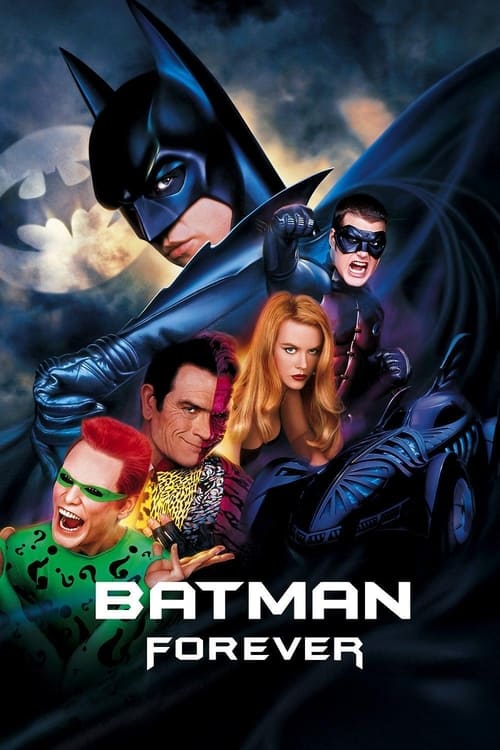
Batman Forever (1995)
Directed by Joel Schumacher
No · Ultra Based
How we score movies →Consciousness Markers
The cast is predominantly white and reflects 1995 mainstream Hollywood demographics. No meaningful diversity in lead or supporting roles. Female characters are limited to romantic roles.
Chase Meridian, the female lead psychologist, exists primarily as a romantic prize. She demonstrates agency only within the framework of male-centered narrative, conforming to traditional damsel-adjacent dynamics.
Chase Meridian delivers occasional psychological exposition, but the film never veers into preachy moralizing about social issues. Schumacher prioritizes spectacle over message.
The film contains no exploration of racial themes, systemic racism, or racial representation. Gotham is presented as a racially unmarked space.
Two-Face's schizophrenia and the Riddler's obsessive behaviors are treated as character quirks and plot devices rather than subject matter for respectful engagement.
Zero LGBTQ+ representation or themes. The film contains no acknowledgment of sexual or gender diversity whatsoever.
Environmental concerns are entirely absent from the narrative. The Riddler's plot involves technology, not ecological themes.
Batman's billionaire status is never questioned. His wealth enables the plot but receives no critical examination. The system that produces billionaire vigilantes remains unexamined.
The film presents conventional beauty standards without challenge. Scarring is presented as deformity that justifies villainy, reinforcing ableist assumptions.
The film contains no historical revisionism. It operates within the established Batman canon without reexamining or reframing historical narratives.


Synopsis
Batman faces off against two foes: the schizophrenic, horribly scarred former District Attorney Harvey Dent, aka Two-Face, and the Riddler, a disgruntled ex-Wayne Enterprises inventor seeking revenge against his former employer by unleashing his brain-sucking weapon on Gotham City's residents. As the caped crusader also copes with tortured memories of his parents' murder, he has a new romance, with psychologist Chase Meridian.
Why it received this score
Batman Forever emerges from a pre-woke cinematic era, a time when superhero films operated under entirely different cultural assumptions. Joel Schumacher's neon-soaked interpretation of Gotham prioritizes stylistic excess over social consciousness, crafting a film that treats mental illness (Two-Face's schizophrenia, the Riddler's obsessive disorders) as mere narrative scaffolding for cartoonish villainy rather than subject matter for nuanced examination. The female lead, psychologist Chase Meridian, exists primarily as a romantic interest and prize to be won, reinforcing traditional gender dynamics that went largely unexamined in mid-90s blockbuster cinema. Nicole Kidman's character represents the intellectual woman who needs saving by the male hero, a trope that would later become subject to considerable critical scrutiny in progressive film discourse.
The cast reflects the demographic realities of 1995 mainstream filmmaking: predominantly white, heterosexual, and arranged according to traditional power structures. The film contains no meaningful exploration of racial dynamics, LGBTQ+ representation, economic justice, environmental concerns, or neurodivergence as anything beyond a plot device. The villains are motivated by personal revenge and ego, not systemic critique. Batman himself remains an unquestioned vigilante billionaire whose vast wealth solves problems that might prompt questions about wealth inequality in a more contemporary lens.
This is a film of pure entertainment, constructed before social consciousness became a measurable metric in mainstream cinema. It neither challenges nor engages with progressive frameworks. It simply exists in a different cultural moment, one where such considerations barely registered in the blockbuster equation. By modern standards, it reads as remarkably unaware of its own ideological positions, which is precisely what we should expect from a 1995 summer action film.
Analysis generated by our Consciousness Algorithm
Critic Reviews
“Unlike Burton, Schumacher doesn't let his stylistic and thematic fascinations run away with him; he keeps one hand on the wheel at all times. The result isn't as emotionally daring and visually outrageous as Burton at his best, but it's better paced and more consistently entertaining from one sequence to the next.”
“It's lighter, brighter, funnier, faster-paced, and a whole lot more colorful than before.”
“Schumacher's method is to use a lighter touch, to stay closer to the cartoon that Bob Kane created for DC Comics in 1939 and to temper Burton's nightmare world with an accessible, brightly colored TV palette.”
“The only thing Schumacher and his scrupulous craftsfolk forgot to give the movie was life -- the energizing spirit of wit and passion that makes scenes work and characters breathe.”