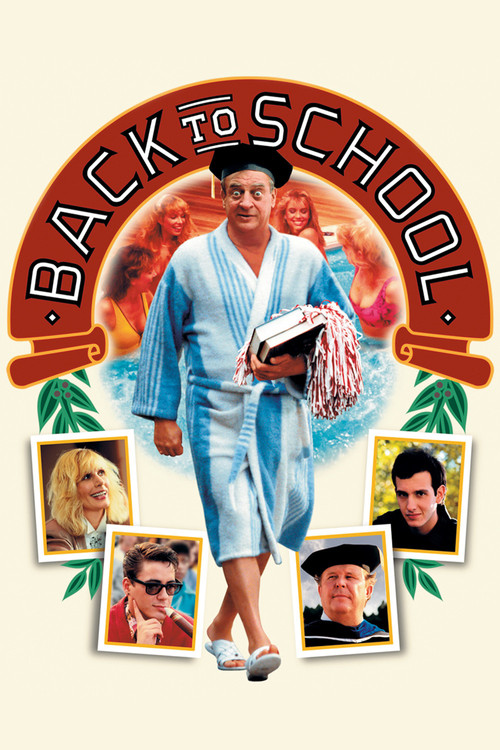
Back to School (1986)
Directed by Alan Metter
No · Ultra Based
How we score movies →Consciousness Markers
The film includes women in professional and romantic roles, but they function primarily as supporting characters in Melon's narrative. No meaningful representation of marginalized groups beyond gender.
The film mocks academic and social pretension and celebrates practical business success, but this is comedic rather than ideologically coherent. No structural critique of capitalism exists.
Female characters exist in the film but are not presented through a feminist lens. They serve primarily to support the male protagonist's arc rather than having agency or thematic significance.
The film contains some comedic scenes involving education and learning, but these function as humor rather than moral instruction. No preachy or preachy tone dominates the narrative.
Rodney Dangerfield's physical comedy relies partly on his appearance, but the film does not engage in body shaming or body positivity discourse. It simply treats physicality as comedic material.
No LGBTQ+ themes, representation, or subtext present in the film. The narrative is entirely heteronormative.
The film does not engage with racial themes or demonstrate racial consciousness. The cast is predominantly white, which reflects 1986 Hollywood norms rather than any intentional diversity initiative.
No climate themes, environmental consciousness, or ecological concern present in the film.
No representation of neurodivergence, mental health, or disability accommodation present in the film.
The film does not engage in historical revisionism or reinterpretation. It is set in the contemporary 1980s without historical claims.


Synopsis
Self-made millionaire Thornton Melon decides to get a better education and enrolls at his son Jason's college. While Jason tries to fit in with his fellow students, Thornton struggles to gain his son's respect, giving way to hilarious antics.
Why it received this score
Back to School operates within the comedic traditions of 1986, a time when progressive sensibilities had not yet calcified into the particular aesthetic markers we now recognize as characteristic of contemporary social consciousness. Rodney Dangerfield's Thornton Melon is a blue-collar millionaire navigating elite academic spaces, and the film does engage with class dynamics and the question of whose knowledge counts, but it does so through the lens of individualist wish fulfillment rather than systemic critique. The humor derives from Melon's fish-out-of-water status, not from any interrogation of educational gatekeeping as a social problem requiring structural redress.
The supporting cast includes women in visible roles (Sally Kellerman as a professor, Terry Farrell as a love interest, Adrienne Barbeau), and the film does not traffic in overt misogyny beyond what was typical for mainstream comedy of the era. However, these female characters exist largely to facilitate Melon's narrative arc. There is no meaningful engagement with LGBTQ+ themes, disability representation, or racial consciousness. The film's anti-capitalist energy, if one were to be generous, might be located in its gentle mockery of academic pretension and its celebration of practical success, but this is not a coherent ideological position so much as a comedic premise.
What we have here is a straightforward comedy from an era that predates the contemporary consciousness we are tasked with measuring. Back to School commits no sins against modern progressive sensibilities because it was made before those sensibilities had been fully articulated as a cultural force. It is, by design, innocent of the markers we now scrutinize. This is not a virtue, merely a historical fact.
Analysis generated by our Consciousness Algorithm
Critic Reviews
“It's a good character for Dangerfield, one that veers him away from the “I don't get no respect” pathos that comes too easily to him, and enough attention is paid to the minimal plot to integrate Dangerfield's classically constructed one-liners into something like a dramatic situation. This is what they mean by “a good vehicle.””
“As vehicles for fat comedians who were big in the States but never exported well go, this self-proclaimed slob comedy is nearly a masterpiece and certainly much better than the comparable Revenge of the Nerds films.”
“In this very funny Rodney Dangerfield comedy, there has been an important shift in Rodney`s entertainment persona, a shift that has made this small film a monster hit.”
“The most jarring casting mistake (even more jarring than the miscasting of Dangerfield) involves Keith Gordon, who plays Thornton's son. Gordon, who has shown himself to be an intense and quirky actor in such films as Christine and Dressed to Kill, is a smoldering presence in what ought to be a light, comic role. His psycho-killer eyes just don't fit here.”