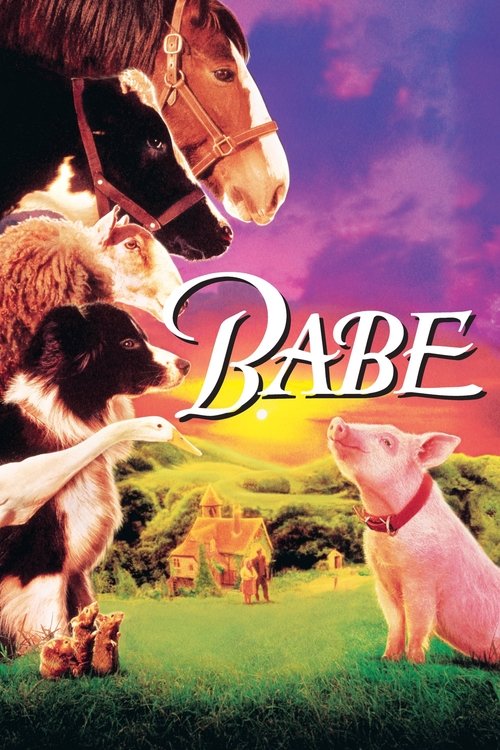
Babe (1995)
Directed by Chris Noonan
No · Ultra Based
How we score movies →Consciousness Markers
The ensemble includes actors from various backgrounds, though this appears incidental rather than intentional diversity programming. The female protagonist (voiced by Christine Cavanaugh) is notable but not explicitly foregrounded as commentary on gender representation.
While the film's central message about kindness and self-determination could be seen as preachy, it is delivered through narrative and character action rather than explicit moral instruction or lecture-style exposition.
While the protagonist is female and the narrative involves self-determination, there is no explicit feminist ideology or engagement with gender politics as a thematic concern.
The film depicts a pre-industrial farming setting and portrays capitalist market forces (livestock trading, slaughter) as a threat to be overcome through alternative values, though this is not developed into explicit anti-capitalist ideology.
No LGBTQ+ themes, characters, or subtext are present in the film. The narrative contains no such elements.
The film contains no engagement with racial themes, racial consciousness, or commentary on race and ethnicity as social structures.
No climate-related messaging or environmental crusade elements appear in the narrative.
No body positivity messaging or commentary on body acceptance appears in the film.
No representation of or engagement with neurodivergence, autism spectrum disorders, or related neurological conditions is present.
The film contains no historical revisionism or reinterpretation of historical events or narratives.


Synopsis
Babe is a little pig who doesn't quite know his place in the world. With a bunch of odd friends, like Ferdinand the duck who thinks he is a rooster and Fly the dog he calls mum, Babe realises that he has the makings to become the greatest sheep pig of all time, and Farmer Hoggett knows it. With the help of the sheep dogs, Babe learns that a pig can be anything that he wants to be.
Why it received this score
Babe remains a curious artifact of mid-1990s family entertainment, a film that aspires toward progressive sentiment without quite understanding what progressive means in the modern sense. The core premise, a pig learning to transcend his biological destiny through determination and kindness, carries echoes of self-actualization rhetoric that would later become staples of contemporary cultural messaging. Yet the film operates in a pre-woke idiom, concerned primarily with individual agency and the erosion of rigid social hierarchies rather than the specific constellation of progressive consciousness that emerged in the 2010s and solidified by the 2020s. Farmer Hoggett speaks little and asks only that Babe be kind, a philosophy that feels almost aggressively apolitical by contemporary standards. The film's implicit animal-rights undertones, while present in the narrative (a pig learning not to be slaughtered), never crystallize into explicit ideological messaging or polemical intent. What we have instead is a genuinely charming meditation on kindness and self-determination rendered in spectacular practical effects and voice work, a film that succeeds on its own terms without feeling compelled to announce its values. It won Oscars for Visual Effects and Sound in 1996, achievements that feel appropriately focused on craft rather than cultural significance. For our purposes, Babe scores low on contemporary progressive markers not because it is regressive, but because it predates the very frameworks we are measuring.
Analysis generated by our Consciousness Algorithm
Critic Reviews
“The all-time great talking-pig movie, a lovely, intelligent gem of G-rated entertainment that is also rib-tickling funny.”
“A witty, stylish, beautifully made charmer of a family picture.”
“That rare movie that completely fulfills its admittedly modest aims.”
“Babe could charm the pants off the most unregenerate cynic.”