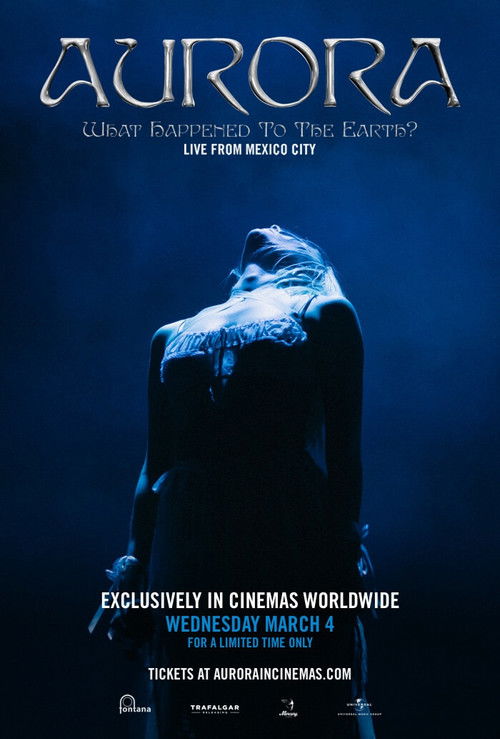
AURORA: What Happened to the Earth? Live From Mexico City (2026)
Directed by Gonzalo Lopez
Partly · Woke-Adjacent
How we score movies →Consciousness Markers
Environmental consciousness is central to AURORA's artistic identity and the concert tour's framing. Her lyrics explicitly address ecological crisis, and she has partnered with Greenpeace and the UN on environmental campaigns. The tour title itself, 'What Happened to the Earth?', foregrounds climate and ecological themes as the organizing principle of the performance.
AURORA's lyrics engage with critiques of global capitalism and consumer culture, and her music frequently addresses the spiritual emptiness of modern consumer life. While not dogmatically anti-capitalist, her artistic practice contains a consistent skepticism toward capitalist systems and their environmental consequences.
The concert features a diverse audience and AURORA herself as the central figure, but the film does not deliberately foreground casting choices or demographic representation. The focus remains on the artist and her performance rather than on representation as a thematic concern.
AURORA's lyrics contain elements of female agency and emotional complexity, and she has spoken about mental health and personal struggle, but the concert film itself does not foreground feminist critique or analysis. Her presence as a powerful solo female artist performing before thousands carries implicit feminist resonance without explicit statement.
The concert takes place in Mexico City on Day of the Dead, a culturally specific setting, and audience members are shown in festive dress. However, the film does not engage in explicit racial or cultural commentary. The location functions primarily as aesthetic backdrop rather than as a site of cultural interrogation.
The choice of Day of the Dead as the filming date carries cultural and historical resonance, but the film does not engage in revisionist historical analysis or reframe historical narratives. The cultural moment is used atmospherically rather than critically.
AURORA's music occasionally touches on themes of identity and emotional vulnerability, and her fanbase includes LGBTQ+ audiences, but the concert film does not explicitly engage with LGBTQ+ themes or representation. No overt markers of LGBTQ+ consciousness are present.
The film is structured as a concert performance, not as a preachy text or lecture. While AURORA's lyrics carry thematic weight, the film does not employ the explicit pedagogical approach of contemporary progressive cinema. It trusts the audience to absorb meaning from the performance itself.
The concert film does not emphasize or celebrate body diversity or challenge conventional beauty standards. The focus remains on AURORA's vocal and artistic performance rather than on body politics or representation.
AURORA has spoken publicly about mental health struggles, but the concert film does not engage with neurodivergence as a theme or foreground disability representation. Mental health references in her music are present but not treated as a central concern of the documentary.
Synopsis
Norwegian alt-pop artist AURORA plays her biggest ever headline performance at Mexico City's Palacio de los Deportes as part of her What Happened to the Earth? Tour. Filmed live on Dia De Los Muertos (Day of the Dead), the arena is transformed into a space of spellbinding sound and light, and filled with fans in festive dress. AURORA's ethereal voice is ever-captivating as she sings haunting ballads including 'Dreams' and 'Exist for Love' as well as fan-favourites 'Runaway', 'The Seed' and 'Churchyard'. Known for blending electronic pop with folk and vivid storytelling, AURORA's performances are always immersive and emotional, and this concert – celebrating nature and the human experience – solidifies her as a beacon of originality and inspiration.
Why it received this score
This concert documentary captures AURORA in her element: a Norwegian alt-pop artist performing before 18,000 devotees on Day of the Dead in Mexico City, every frame suffused with the kind of visual and spiritual intensity that her fanbase has come to expect. The film functions less as a traditional concert recording and more as a meditation on nature, mortality, and existential longing, themes that have defined her career and activism. The staging is deliberately ethereal rather than bombastic, befitting an artist whose lyrics frequently grapple with environmental collapse and the spiritual malaise of modern capitalism.
What emerges from the research is a clear picture of an artist whose progressive sensibilities are both genuine and deeply integrated into her artistic practice. AURORA has collaborated with Greenpeace, credited nature as an artist on streaming platforms through the UN's Sounds Right campaign, and uses her platform to advocate for mental health awareness and children affected by conflict. She is not performing social consciousness as a marketing exercise, but rather as the substance of her work. This concert film, by capturing her at scale, documents an artist at the precise intersection of commercial success and activist commitment.
Yet the film itself remains fundamentally a concert document, which constrains its capacity for explicit cultural argumentation. There is no talking head analysis, no preachy framing, no direct statement of political position. The audience sees AURORA's artistry and hears her lyrics, which carry their own weight, but the film does not interrogate or expand upon these themes with the kind of intentional preachiness that would push its score higher. It is a celebration of an artist's vision rather than a work that explicitly constructs an argument about the state of the world.
Analysis generated by our Consciousness Algorithm
Critic Reviews
“Over a difficult three-hour sprawl, Cristi Puiu's Aurora fully explores the time before and after a killer strikes, and it has the cumulative effect of making what passes for a "motive" seem absurdly simplistic. ”
“A quiet, steady burn filled with stretches of unsettlingly reverberant silence cleaved in half by a midpoint eruption of violence. Here there is before, and then there is after. ”
“A slow burn thriller taken to the extreme, Cristi Puiu's Aurora continues the Romanian writer-director's obsession with time as his main narrative device.”
“Puiu offers zero insight into his character; only suckers will find the pose artful or nourishing. Skip it.”