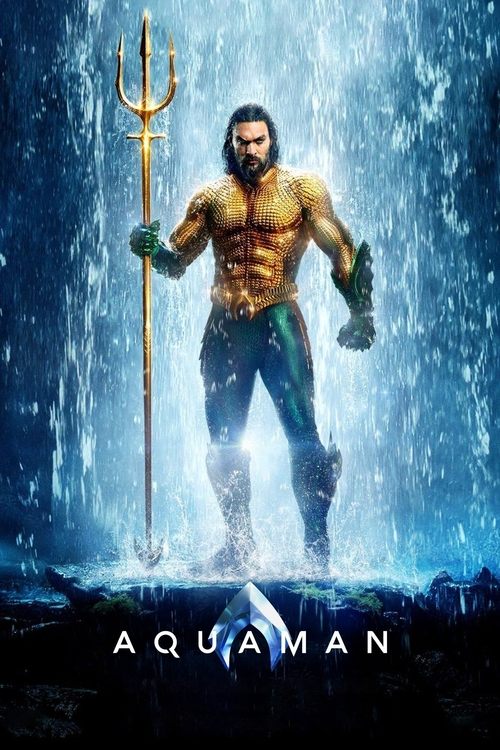
Aquaman (2018)
Directed by James Wan
No · Ultra Based
How we score movies →Consciousness Markers
The cast includes actors of various ethnicities in supporting and co-lead roles, but representation feels perfunctory rather than purposeful. Diversity exists without being meaningfully integrated into the narrative or thematic concerns.
Female characters participate in action sequences and hold nominal power, but they exist primarily to support the male protagonist's journey. Mera and Atlanna lack independent agency and are not central to the narrative's concerns.
While the cast is racially diverse, the film makes no effort to explore race, identity, or systemic inequality. Characters of color are present without the film engaging with any aspect of their lived experience.
The film presents idealized, muscular bodies as the norm without commentary. There is no meaningful engagement with diverse body types or body image beyond conventional action film aesthetics.
While the film creates an alternate underwater history, it does not engage with real historical revision or recontextualization. Its mythology is purely fantastical and ahistorical.
Despite an ocean setting, the film shows little concern for environmental issues or climate consciousness. Pollution and ecological destruction are mentioned but never seriously interrogated.
The narrative celebrates Arthur's ascension to kingship without questioning hierarchical power structures or wealth inequality. Atlantean society is presented as natural rather than constructed.
There is no meaningful LGBTQ+ representation or thematic content in the film. No characters are coded as queer, and no relationships explore non-heterosexual dynamics.
The film is uninterested in explaining or justifying its worldbuilding through dialogue. It moves forward through plot and spectacle without attempting to educate or persuade the audience about its themes.
There is no representation of neurodivergent characters or any thematic engagement with neurodiversity in the film.


Synopsis
Half-human, half-Atlantean Arthur Curry is taken on the journey of his lifetime to discover if he is worth of being a king.
Why it received this score
Aquaman presents itself as a grand underwater adventure with sufficient diversity in its casting to avoid charges of exclusion, yet it remains fundamentally a conventional superhero spectacle unconcerned with interrogating its own mythology or the social systems it depicts. James Wan's direction prioritizes visual spectacle over thematic coherence, and the film's treatment of power structures, environmental concerns, and gender dynamics rarely transcends the surface level. Arthur Curry's journey to kingship involves no meaningful reflection on the nature of rule itself, while the film's geopolitical tensions between surface and ocean worlds are presented as abstract conflicts rather than anything resembling social commentary.
The female characters, notably Nicole Kidman's Atlanna and Amber Heard's Mera, function primarily as motivational devices for the male protagonist rather than as fully realized agents within their own narrative. Mera possesses agency in combat sequences but exists largely to guide and support Arthur's arc. The casting of Yahya Abdul-Mateen II and Ludi Lin in substantial roles demonstrates a surface-level commitment to representation, though these actors serve the plot machinery without the film engaging seriously with questions of identity or belonging. There is no interrogation of class structures within Atlantean society, no meaningful engagement with environmental destruction despite the oceanic setting, and no effort to complicate the hero's path to power through a lens of social consciousness.
This is a film that succeeds as entertainment precisely because it asks nothing difficult of itself or its audience. It is visually accomplished and economically efficient in its storytelling, but it remains innocent of the cultural preoccupations that would mark it as contemporary in any meaningful sense. Aquaman operates in the register of timeless fantasy adventure, which is to say it operates in the register of 1980s filmmaking sensibilities, merely updated with contemporary digital effects and a more diversified cast. The result is pleasant, profitable, and entirely unremarkable from the perspective of cultural consciousness.
Analysis generated by our Consciousness Algorithm
Critic Reviews
“Aquaman is as concerned with scientific accuracy as “SpongeBob Squarepants.” And that’s one of many reasons why I like it. ”
“It’s a weird and wonderful superhero adventure that strives — and almost succeeds — to be the most epic superhero movie ever made.”
“Aquaman is worth seeing if only for its original visuals and the grand vision from director James Wan. As a whole, it is a bit of a mess and ends up being an exhausting experience that would’ve benefited from some judicious editing.”
“It seems director James Wan had one overarching goal in making “Aquaman.” His prime directive? Crush the audience into submission.”