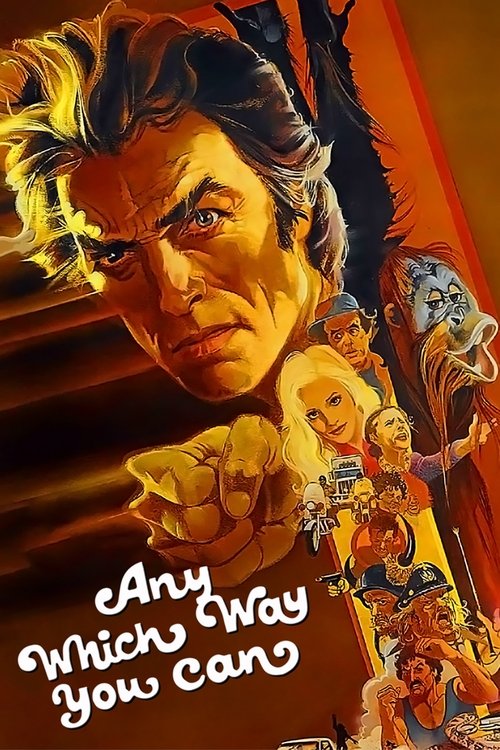
Any Which Way You Can (1980)
Directed by Buddy Van Horn
No · Ultra Based
How we score movies →Consciousness Markers
Sondra Locke appears in a supporting romantic role, but female characters are sparse and one-dimensional. The cast is overwhelmingly male and reflects no intentional diversity in representation.
Women exist primarily as romantic interests and emotional support for the male protagonist. No examination of gender dynamics or feminist themes. Female agency is minimal.
The film celebrates the male body primarily as an instrument of violence and physical dominance. Body positivity is absent, replaced by conventional masculine physicality as spectacle.
No LGBTQ+ themes, characters, or representation present. The film shows no awareness of LGBTQ+ existence.
The film contains no engagement with racial themes, no commentary on race relations, and no evidence of racial consciousness in its narrative or casting choices.
Climate change and environmental concerns are entirely absent from the film's worldview. The film shows no awareness of ecological issues.
The plot involves fighting for money and organized crime but presents these as plot mechanics rather than systemic critique. There is no anti-capitalist sentiment or examination of economic exploitation.
No representation of neurodivergent characters or conditions. The film shows no awareness of neurodiversity as a concept.
The film contains no historical narrative or revisionist historical claims. It is set in a contemporary 1980 America with no historical pretensions.
The film contains no preachy impulses, no lectures on social issues, and no attempts to educate the audience about social problems or progressive values.


Synopsis
Philo takes part in a bare knuckle fight – as he does – to make more money than he can earn from his car repair business. He decides to retire, but when the Mafia come along and arrange another fight, he's pushed into it. A motorcycle gang and an orangutan called Clyde all add to the 'fun'.
Why it received this score
Any Which Way You Can stands as a monument to an era when cinema asked few questions about its social dimensions and fewer still about representation. This 1980 sequel trades in the uncomplicated pleasures of Clint Eastwood punching things, repeatedly, with minimal narrative justification. The presence of Sondra Locke in a supporting role represents the film's most progressive element, though describing it as such requires lowering one's standards considerably. She functions primarily as romantic interest and emotional anchor for the protagonist, a configuration as dated as the film's synth-heavy score.
The narrative concerns itself entirely with bare-knuckle fighting tournaments, motorcycle gang violence, and the various hijinks of an orangutan named Clyde. There is no discernible engagement with gender dynamics, racial consciousness, or any of the social frameworks that would later define progressive filmmaking. The female characters exist in a state of benign irrelevance, present mainly to react with concern or admiration to Eastwood's physical prowess. The film's comedy derives almost entirely from slapstick violence and animal antics rather than any satirical commentary on masculinity, capitalism, or social structures.
The film is not offensive in its retrograde sensibilities because it is too simple to harbor opinions at all. It simply exists, a relic of a time when action cinema could be entirely untethered from social consciousness. An orangutan receives as much character development as any human supporting player, which tells us everything about the film's relationship to narrative complexity.
Analysis generated by our Consciousness Algorithm
Critic Reviews
“Any Which Way You Can is a loose, lighthearted Eastwood vehicle aimed at the good-timey sector of this actor's audience. The real star of this series is Clyde the orangutan, and it looks as if Clyde has another hit on his hairy hands.”
“A generous entertainment of its kind, Any Which Way mixes plentiful portions of gauche, robust action and comedy with frequent musical interludes. [17 Dec 1980, p.E1]”
“The movie is less a sequel to the original, in fact, than it is a remake - a more energetic, more absurd and possibly more entertaining remake. [17 Dec 1980]”
“Eastwood at his least appealing in a poor sequel to the already disappointing redneck comedy of Every Which Way But Loose. The story is similarly thin - trucker Eastwood, accompanied by his orang-utan buddy Clyde, gets involved in repetitive brawls with sundry unsavoury brutes - while the humour is far too broad and the direction plodding.”