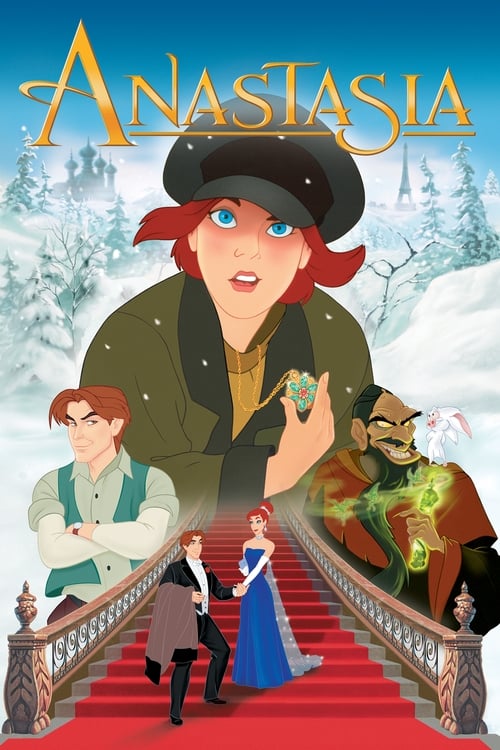
Anastasia (1997)
Directed by Gary Goldman
No · Ultra Based
How we score movies →Consciousness Markers
The film transforms the actual Russian Revolution and the Romanov family tragedy into a fantasy narrative with supernatural villains, which constitutes a significant reimagining of historical events, though this operates at the level of genre fantasy rather than deliberate revisionism.
The protagonist is a capable woman who acts with agency, but the narrative is primarily defined by family reunion and romance rather than any critique of gender dynamics or exploration of women's autonomy.
The cast includes some ethnic diversity in supporting roles typical of 1990s animation, but this reflects standard practice rather than deliberate progressive casting choices or commentary.
Two con men central to the plot engage in deception for financial gain, but the film treats this as morally neutral character quirk rather than systemic critique.
No LGBTQ+ themes, characters, or representation are present in the film.
The film contains no exploration of racial themes, racial identity, or racial consciousness of any kind.
Climate themes are entirely absent from this fantasy adventure film.
The film presents conventionally attractive animated characters without any engagement with body diversity or body positivity messaging.
No representation of or engagement with neurodivergence is present in the film.
The film contains no preachy speeches, moral lectures, or attempts to instruct the audience about social issues.


Synopsis
Ten years after she was separated from her family, an eighteen-year-old orphan with vague memories of the past sets out to Paris in hopes of reuniting with her grandmother. She is accompanied by two con men, who intend to pass her off as the Grand Duchess Anastasia to the Dowager Empress for a reward.
Why it received this score
Anastasia arrives as a curious artifact of the pre-woke animation era, a 1997 fantasy that concerns itself primarily with spectacle, romance, and narrative momentum rather than the cultivation of progressive social consciousness. The film does feature a female protagonist who demonstrates agency and determination, though she remains fundamentally defined by her relationship to her lost family and a romantic subplot rather than any independent ambition or critique of systems. The antagonist, Rasputin, is presented as a supernatural villain bent on revenge against the Romanov family itself, which transforms historical atrocity into fairy tale metaphor without engaging meaningfully with the actual tragedy or its implications. The supporting cast is diverse in the manner of 1990s animation, meaning it includes several characters of various ethnicities, but their inclusion serves narrative function rather than any deliberate statement about representation or belonging.
The film's engagement with feminist themes amounts to little more than depicting a woman who can run, fight, and make decisions without male permission, a baseline that was already becoming standard in mainstream animation by the late 1990s. There is no interrogation of gender roles, no discussion of women's autonomy or power, and no critique of the patriarchal structures that would have governed Anastasia's actual historical circumstances. The romance plot, while not dominant, affirms rather than questions traditional courtship dynamics. The production itself was mounted with considerable technical ambition for its era, but that ambition was directed toward visual spectacle rather than thematic depth or cultural commentary.
What remains striking about Anastasia is precisely its lack of self-consciousness about any of this. The film does not attempt to be progressive, does not signal its awareness of contemporary social movements, and does not burden itself with the need to justify its narrative choices through the lens of modern sensibilities. It is, in this respect, genuinely innocent of the markers that would define cultural consciousness in the subsequent decades. One watches it now not as a statement of anything in particular, but as a period piece that documents the preoccupations of 1990s family entertainment before the seismic shift in how studios would approach these same narratives.
Analysis generated by our Consciousness Algorithm
Critic Reviews
“A gorgeous piece of work. It pulls every heartstring a good romance should, yet bursts with G-rated fun, wonderfully human characters and several solid and hummable songs.”
“Picks and chooses cleverly, skipping blithely past the entire Russian Revolution but lingering on mad monks, green goblins, storms at sea, train wrecks and youthful romance.”
“Easily the best non-Disney animated movie in recent memory, and it is good enough to rival such titles as “The Lion King” and “Aladdin.””
“You can set your watch to the musical cues, and the songs themselves are forgettable at best, insipid at worst.”