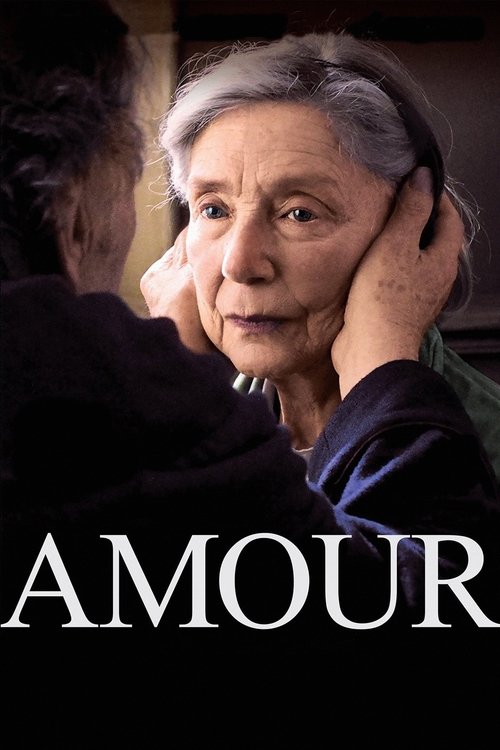
Amour (2012)
Directed by Michael Haneke
No · Ultra Based
How we score movies →Consciousness Markers
Emmanuelle Riva's casting at 88 years old is notable for her age, and she received an Oscar nomination. However, the film makes no deliberate statement about representation or diversity in casting choices.
Anne is an intelligent, educated woman and former music teacher, but the film does not engage with feminist discourse or gender politics. Her agency is progressively stripped by illness rather than examined through a gendered lens.
Anne's stroke results in aphasia and cognitive decline, which the film depicts clinically and realistically. However, this is presented as suffering and loss rather than neurodivergence to be reframed or celebrated.
Haneke's films demand audience reflection and discomfort, but 'Amour' achieves this through intimate domestic drama rather than explicit preachiness or preaching.
No LGBTQ+ themes, characters, or content present in the film.
No racial themes, characters of color, or racial consciousness present. The narrative concerns a white Parisian couple.
No environmental messaging, climate themes, or ecological consciousness present.
While the couple are retired and removed from economic production, the film contains no critique of capitalism or class consciousness.
Anne's physical decline and bodily deterioration are depicted with unflinching realism. The film presents aging and illness as loss, not through a body-positive framework.
No historical narrative, revisionism, or engagement with historical discourse present.


Synopsis
Georges and Anne are in their eighties. They are cultivated, retired music teachers. Their daughter, who is also a musician, lives abroad with her family. One day, Anne has a stroke, and the couple's bond of love is severely tested.
Why it received this score
Haneke's "Amour" is a masterwork of existential cinema that concerns itself with the most ancient and universal of human struggles: aging, illness, and mortality. The film observes an elderly Parisian couple with anthropological precision as they navigate Anne's stroke and its devastating consequences. What makes this work remarkable is its absolute refusal to sentimentalize or aestheticize suffering. The camera watches unflinchingly as bodily functions fail, as speech becomes impossible, as the person one has loved for a lifetime gradually becomes unreachable.
The film's apparent lack of cultural positioning is, in fact, its defining feature. Haneke operates in a space entirely orthogonal to contemporary progressive discourse. His interest is not in representation, identity, or social systems, but in the raw phenomenology of human experience at its most stripped-down. Emmanuelle Riva's performance, delivered at 88 years of age, achieves a kind of tragic grandeur precisely because it refuses to be inspiring or uplifting. There is no triumph here, no narrative arc toward wisdom or acceptance. There is only the slow, inexorable process of dissolution and the question of how love persists in the face of it.
This is a film about mortality that does not traffic in the language of modern social consciousness. It does not ask us to expand our thinking about identity or systemic injustice. It asks only that we bear witness to the fact of human suffering and the bonds that remain even when everything else is stripped away. In the landscape of contemporary cinema, such absolute commitment to the particular and the personal reads as almost radical in its refusal to perform progressive awareness.
Analysis generated by our Consciousness Algorithm
Critic Reviews
“Michael Haneke's Palme D'Or winner is uncomfortable, uncompromising, unflinching... and utterly unmissable. Old age may not be a reality you wish to confront, but you must see this film.”
“A compassionate, masterful work that deservedly won Haneke a second Palme d'Or after "The White Ribbon's" 2009 victory. Best to avoid on a first date, though.”
“Considering Haneke's confrontational past, this poignantly acted, uncommonly tender two-hander makes a doubly powerful statement about man's capacity for dignity and sensitivity when confronted with the inevitable cruelty of nature. ”
“Haneke remains, by his rules, infallible. So what? A movie in which incident is as spare as it is in Amour can certainly be great; a movie in which ideas and feelings are so sparse cannot.”