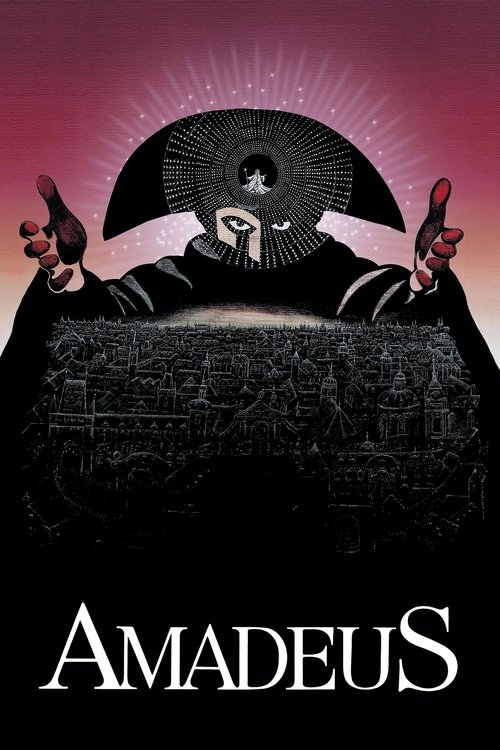
Amadeus (1984)
Directed by Miloš Forman
No · Ultra Based
How we score movies →Consciousness Markers
The film critiques aristocratic patronage systems and the commodification of artistic talent, though this is historical observation rather than contemporary political consciousness.
Female characters exist primarily as wives, mothers, and decorative presences. Constanze Mozart is supportive but lacks agency or narrative centrality.
The cast is entirely white and reflects 18th-century European aristocracy without any contemporary awareness of representation. No meaningful diversity in principal roles.
The film takes considerable creative liberty with Mozart's biography and Salieri's character, but this is dramatic license rather than revisionist history with contemporary political purpose.
No LGBTQ+ themes, representation, or narrative elements present in the film.
No engagement with racial themes or consciousness. The film contains no characters of color in meaningful roles.
No environmental or climate-related themes present. The film is set in the 18th century with no contemporary environmental commentary.
No body positivity themes or commentary. The film contains no engagement with contemporary body politics.
No representation or discussion of neurodivergence. The film does not address disability or cognitive difference.
The film trusts the audience to follow a complex narrative without preachy explanation or explicit thematic articulation. Minimal lecture energy.


Synopsis
Disciplined Italian composer Antonio Salieri becomes consumed by jealousy and resentment towards the hedonistic and remarkably talented young Salzburger composer Wolfgang Amadeus Mozart.
Why it received this score
Amadeus stands as a monument to the pre-contemporary era of cinema, when filmmakers concerned themselves with the clash of artistic temperaments rather than the census demographics of their casting. Miloš Forman's baroque masterpiece examines jealousy, genius, and the corruption of merit within aristocratic patronage systems, concerns that animated the artistic community of the 18th century but hold no particular relationship to modern social consciousness. The film is, in its way, perfectly calibrated to ignore the entire framework of contemporary progressive sensibility: it presents an all-white cast in a historical setting without comment, features women primarily as wives and mothers, and maintains no engagement whatsoever with systemic critique, environmental concerns, or the politics of representation.
The film trusts its audience to navigate a complex psychological drama without preachy prompting, which is to say it operates under assumptions incompatible with contemporary narrative practice. There is no lecture energy because there is no lecture. Mozart's hedonism reads as a mild subversion of propriety, and the film's portrayal of lower-class life in Vienna contains certain implicit acknowledgments of social stratification, but these represent the bare minimum of historical realism rather than conscious progressive intervention.
The film's indifference to the categories we now use to evaluate cultural products is, from a certain angle, the most honest position available. It does not pretend to diversity it does not possess, nor does it retrofit contemporary values onto a historical setting. This integrity places it squarely in the category of work that preceded our current moment of cultural consciousness entirely. It is a masterpiece from before we invented the thing we are measuring.
Analysis generated by our Consciousness Algorithm
Critic Reviews
“Remains the most popularly successful film ever to render the inner life of an artist.”
“It still soars, but now it seems richer, more expansive. Amadeus reminds us that movies can be lyrical as well as vulgar, ambitious as well as playful, brilliant as well as down and dirty -- just like Amadeus himself.”
“One of the finest qualities of Amadeus is that it reminds us of those rare occasions when an Oscar sweep is actually merited.”
“This movie Mozart seems little more than a wild and crazy music-maker, whose biggest problem was that his compositions had "too many notes." And that, as Forman's Mozart might say, ain't much. [20 Sep 1984, p.C1]”