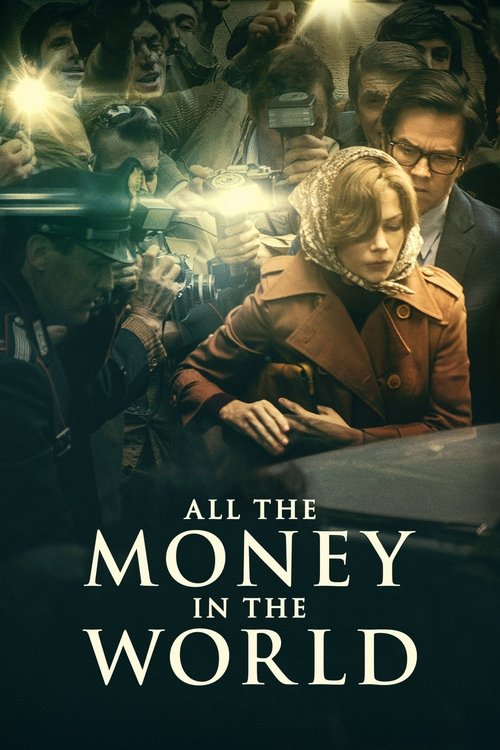
All the Money in the World (2017)
Directed by Ridley Scott
Partly · Woke-Adjacent
How we score movies →Consciousness Markers
The film explicitly critiques billionaire greed through Getty's refusal to ransom his grandson, presenting extreme wealth accumulation as morally reprehensible and a barrier to human compassion.
The female lead possesses agency and drives the narrative, though this reflects character necessity rather than explicit feminist messaging or thematic engagement.
Michelle Williams anchors the film as a strong female protagonist, but the supporting cast is uniformly white and lacks notable diversity in representation.
While the film avoids overt preachiness, its critique of Getty's wealth and miserliness carries some heavy-handed moral messaging.
No LGBTQ+ themes, characters, or representation present in the film.
The film does not engage with racial themes or consciousness. It is set entirely within white, wealthy circles.
No environmental or climate-related themes are present in this crime thriller.
No engagement with body diversity or body positivity themes in the film.
No representation or thematic engagement with neurodivergence present in the narrative.
The film adapts a true historical event with relative fidelity rather than revisionist reinterpretation.


Synopsis
The story of the kidnapping of 16-year-old John Paul Getty III and the desperate attempt by his devoted mother to convince his billionaire grandfather Jean Paul Getty to pay the ransom.
Why it received this score
Ridley Scott's film tells the true story of the 1973 Getty kidnapping with the steady craftsmanship one expects from a director of his caliber. The film's primary progressive credential derives from its scathing portrait of billionaire Jean Paul Getty, whose pathological refusal to ransom his own grandson serves as an indictment of unfettered wealth accumulation. Michelle Williams carries much of the film's emotional weight as Gail Harris, the determined mother whose moral clarity provides the narrative's backbone. She is allowed agency and intelligence, though her competence feels more like character necessity than ideological statement.
Beyond this anti-capitalist spine, however, the film remains remarkably indifferent to contemporary cultural preoccupations. It contains no meaningful engagement with questions of representation, identity, or systemic inequality. The supporting cast is uniformly white and wealthy. The story unfolds in a rarefied world of privilege, which the film documents without interrogating beyond the surface critique of Getty's miserliness. The narrative treats its historical material with relative fidelity rather than revisionist impulse.
What unfolds is a competently made thriller that happens to contain one thematically progressive element amid an otherwise apolitical framework. The film's score reflects this singular dimension of cultural consciousness rather than any systematic commitment to progressive sensibility. It is a kidnapping drama first and foremost, not a vehicle for cultural activism.
Analysis generated by our Consciousness Algorithm
Critic Reviews
“It’s as realized a thriller as you are likely to find, not only in the precision of its performances, but in its evocative use of location (Rome, London), its period detail (especially Williams’ clothing) and the tension of the younger Getty’s months-long captivity.”
“Some people will think it’s a bizarre mess, others an unconventional masterwork. If there’s any justice in the world, the latter group will win out. ”
“It's a true-life yarn loaded with extremes, of wealth, personal eccentricities, grief, tension, daring, criminal means to political ends, maternal drive and luck, both bad and good. It is also a peek into a rarefied world where money knows no bounds and yet means everything.”
“As released, All the Money in the World is by and large a conspicuously manufactured thriller that moves between manipulative psych-outs. ”