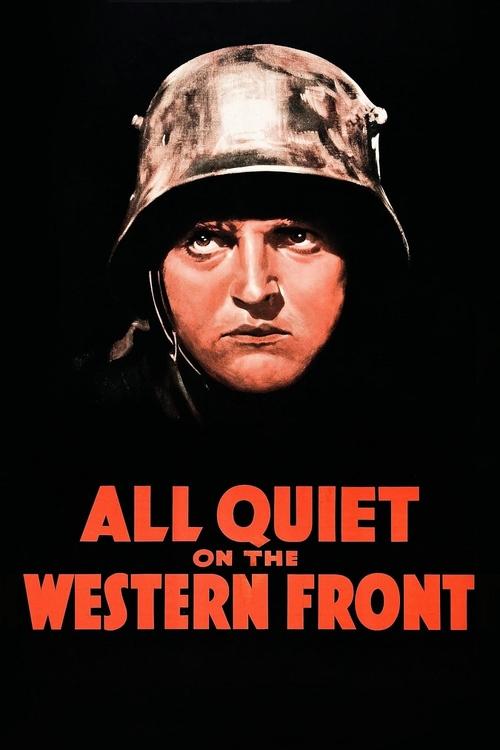
All Quiet on the Western Front (1930)
Directed by Lewis Milestone
No · Ultra Based
How we score movies →Consciousness Markers
The film presents a revisionist view of World War I as senseless and morally corrupting, departing from nationalist triumphalism. This is a genuine moral perspective, though not 'revisionist' in the contemporary social justice sense.
The film features an all-male ensemble cast reflecting historical military reality, with no deliberate effort to diversify representation across identity categories.
No LGBTQ+ themes, characters, or subtext appear in the film. The narrative focuses exclusively on heterosexual male soldiers.
Female characters are entirely absent or peripheral. There is no engagement with feminist themes or gender politics in any contemporary sense.
The film depicts German soldiers without any exploration of racial consciousness, colonial guilt, or racial justice themes.
Climate change and environmental consciousness are entirely absent from the narrative and thematic concerns.
While the film critiques nationalism and the machinery of war, it does not engage in critique of capitalism or class struggle in modern progressive terms.
Body positivity as a contemporary concept is not present. The film depicts physical trauma realistically without commentary on body diversity.
Neurodivergence is not addressed or represented. Shell-shocked soldiers are depicted without modern frameworks of psychological disability.
The film trusts its narrative and imagery to convey meaning without preachy exposition or characters delivering lectures about ideology.


Synopsis
When a group of idealistic young men join the German Army during the Great War, they are assigned to the Western Front, where their patriotism is destroyed by the harsh realities of combat.
Why it received this score
Lewis Milestone's "All Quiet on the Western Front" stands as a masterwork of anti-war cinema, yet it would be a profound category error to evaluate it through the lens of contemporary progressive cultural markers. The film's moral seriousness, its unflinching depiction of combat's horror, and its humanist critique of nationalist fervor are all substantial achievements. None of these qualities, however, constitute what we now recognize as modern social consciousness. The film concerns itself with the universal tragedy of young men sent to die for abstract ideals, not with the representation of marginalized groups or the interrogation of systemic power structures that would later become central to progressive discourse.
The narrative presents an entirely male ensemble cast navigating the Western Front with brutal realism. The absence of female characters beyond peripheral background figures reflects the historical reality of trench warfare, not a deliberate creative choice animated by contemporary sensibilities about representation. This is precisely the distinction we must maintain: a film can be profoundly moral without being engaged in the project of modern identity politics. The film's power derives from its commitment to depicting individual suffering and the senselessness of industrial warfare, concerns that transcend the categorical frameworks applied to films made after the cultural reckoning that began in the 2010s.
"All Quiet on the Western Front" belongs to a different era of filmmaking, one in which the very concept of cultural consciousness as we now understand it had not yet crystallized. To score it highly on contemporary progressive markers would be to commit a fundamental anachronism, projecting backward onto a work that operated within entirely different assumptions about what cinema should accomplish. The film's legacy rests secure in its artistic achievement and moral clarity. This assessment reflects no judgment on the film's quality, only a recognition that it inhabits a separate historical moment.
Analysis generated by our Consciousness Algorithm
Critic Reviews
“A harrowing, gruesome, morbid tale of war, so compelling in its realism, bigness and repulsiveness that Universal’s Western Front becomes at once a money picture.”
“Anti-war statements of the cinema in the subsequent 80 years have occasionally surpassed Lewis Milestone’s technically and artistically groundbreaking film, but few can match it for relentless despair or elemental fury—both on and off the battlefield.”
“Perhaps the greatest antiwar film ever made, holding considerable power even now due to Lewis Milestone's inventive direction.”
“The point of the film gets to you, and though you may wince at the lines Maxwell Anderson wrote (every time he opens his heart, he sticks his poetic foot in it), you know what he means.”