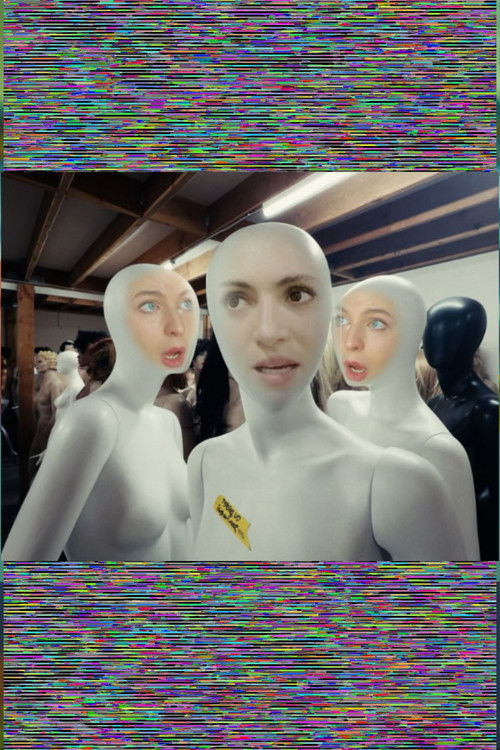
Alexis Taylor - Out of Phase ft. Lola Kirke (2026)
Directed by Will Kindrick
No · Ultra Based
How we score movies →Consciousness Markers
The eerie escalators and singing mannequins could, with sufficient squinting, be read as a consumerist hellscape. This is a generous interpretation and the filmmakers appear to have intended pure surrealism.
The video features Alexis Taylor and Lola Kirke in an abstract surrealist context. There is no evidence that casting choices were made with representation agendas in mind.
No LGBTQ+ themes, characters, or messaging are present. The project is occupied entirely with mannequins and escalators, which have no known sexual orientation.
Lola Kirke's presence provides emotional contrast to the digital landscape, but there is no feminist framing, messaging, or subtext discernible in the work.
No racial themes, commentary, or consciousness of any kind surfaces in this project. The digital nightmares are equal-opportunity unsettling.
No climate themes are present. The environmental footprint of filming on an iPhone 16 is, one presumes, negligible, but the film does not mention this.
No body positivity messaging or themes are present. The mannequins, notably, have idealized forms, but no one comments on this.
No neurodivergence themes are present. The psychological unease is of the Lynchian variety, not the advocacy variety.
There is no history to revise. The video exists in a dimension that appears to predate recorded events.
The work makes no argument, delivers no message, and asks nothing of the viewer except tolerance for dread. It is, in this respect, a relief.
Synopsis
Alexis Taylor (of Hot Chip) braves a strange world of eerie escalators, singing mannequins, and digital nightmares in the experimental music video shot entirely on the iPhone 16.
Why it received this score
There is a particular kind of artistic project that arrives fully insulated from the demands of the cultural moment, and "Out of Phase" is that project. Directed by Will Kindrick and shot entirely on an iPhone 16, this four-minute experimental music video for Alexis Taylor of Hot Chip exists in a Lynchian register of eerie escalators and singing mannequins that is too busy being unsettling to concern itself with the discourse. It is, by the metrics of this publication, almost aggressively inert. We have searched for the lecture. There is no lecture.
Taylor has cited the late David Lynch as a guiding spirit, and the influence is legible in every uncanny frame. Lola Kirke drifts through the digital chaos as a figure of emotional contrast, which is to say she is present and human in a world that is neither. The iPhone 16 production method has been noted approvingly in coverage as a gesture toward accessibility and innovation, and it may well be both of those things, but it does not transform the work into a manifesto. A surrealist nightmare filmed on consumer hardware is still a surrealist nightmare. The hardware is beside the point.
The sole concession to anything approaching a contemporary social register is the video's ambient suggestion of technological alienation, the sense that the digital world is a place of dread rather than liberation. This is, at this point, a sentiment shared by virtually everyone across the political spectrum, from Silicon Valley skeptics to people who simply cannot find their keys because their phone died. It does not constitute a score. "Out of Phase" is content to be strange, sad, and cool, and it achieves all three without asking for credit.
Analysis generated by our Consciousness Algorithm