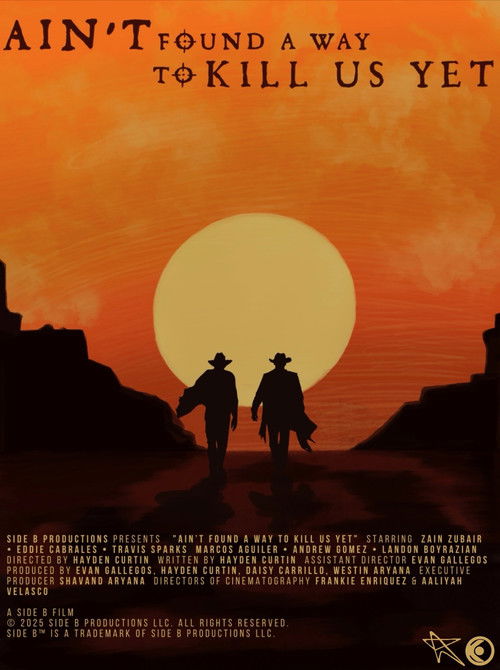
Ain't Found A Way To Kill Us Yet (2026)
Directed by Hayden Curtin
No · Ultra Based
How we score movies →Consciousness Markers
The post-apocalyptic setting creates a fictional wasteland that could be read as revisionist to western tropes, though this appears incidental rather than intentional commentary on historical narratives.
The cast appears to be drawn from a tight-knit production circle, with minimal indication of deliberate diversity initiatives. Casting decisions seem to reflect availability rather than any conscious effort toward representation.
While the cast includes members of various backgrounds, there is no evidence of the narrative engaging with racial themes, commentary, or consciousness. Characters simply exist in the story.
The protagonists are male. No indication of feminist themes, female agency, or gender-conscious narrative elements in the synopsis or available descriptions.
The wasteland setting could theoretically address environmental collapse, but the available plot information suggests it is merely a backdrop for the action narrative rather than a thematic concern.
The film appears to be a straightforward action narrative without preachy elements. At twenty-two minutes, there is minimal room for exposition or thematic explanation.
No evidence of LGBTQ+ themes, representation, or subtext in the available plot information. The film appears to be a straightforward action narrative focused on bounty hunting.
No evidence of anti-capitalist themes, critiques of wealth inequality, or economic consciousness in the plot summary or available materials.
The film is an action western with no apparent commentary on body standards, beauty norms, or body diversity. No relevant content detected.
No indication that the film engages with neurodivergence, disability representation, or neurological diversity in its narrative or character development.
Synopsis
Bounty hunters Dutch and Malone travel The Wastes to track down their target, The Thumb.
Why it received this score
Here we have a micro-budget post-apocalyptic western that has apparently taken the cultural mandate of the 2020s entirely in stride by ignoring it completely. At twenty-two minutes and $1,200, "Ain't Found A Way To Kill Us Yet" represents a purity of vision: two men travel a wasteland to hunt a cult leader. The plot, if we can call it that, proceeds with the narrative momentum of a man trudging through sand. No themes announce themselves. No lectures emerge from the dialogue. The cast, drawn from what appears to be a circle of friends and colleagues, simply exists in the story without performing the labor of representation. This is either admirable or bewildering, depending on one's perspective. Hayden Curtin, in his directorial debut, was simply trying to make a western and did not pause to consider whether the endeavor required social consciousness. The film's complete indifference to contemporary cultural expectations is almost refreshing in its obliviousness. We are left with a work of pure genre exercise, untouched by the concerns that animate so much contemporary cinema. Whether this constitutes a feature or a limitation remains an open question. The film arrives as a short film untethered from the pressures of the modern moment, a small stone rolling downhill without commentary.
Analysis generated by our Consciousness Algorithm