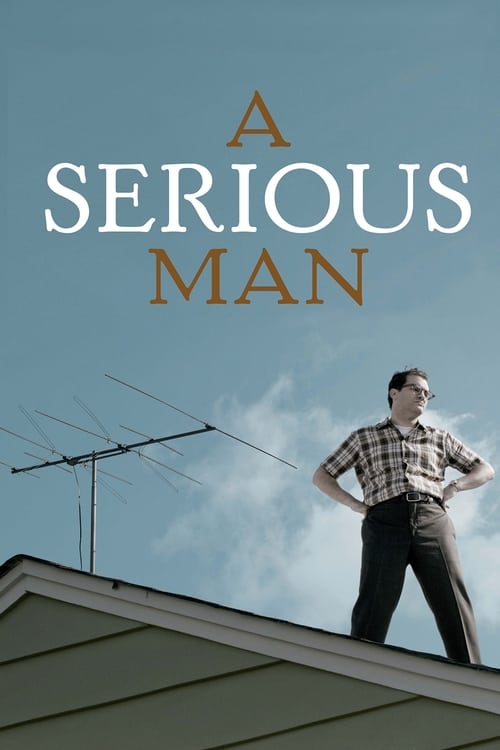
A Serious Man (2009)
Directed by Ethan Coen
No · Ultra Based
How we score movies →Consciousness Markers
The Yiddish prologue and the protagonist's philosophical questioning about faith and meaning approach preachiness, though this is relatively restrained and integrated into narrative structure.
The film features a Jewish cast in a Jewish community, but this reflects the story's setting rather than conscious representation efforts. Casting is organic to narrative context.
No LGBTQ+ themes, characters, or storylines are present in the film.
Female characters are peripheral and function primarily as plot devices or objects of male frustration. They lack independent agency or meaningful character arcs.
The film contains no engagement with racial themes or racial consciousness. It is set in a predominantly white community.
No environmental or climate-related themes are present in the narrative.
While exploring middle-class anxieties, the film does not critique capitalism or present anti-capitalist messaging.
No body positivity themes or discussions of body image appear in the film.
The protagonist's psychological distress is not framed through a neurodivergent lens or explicitly addressed as such.
The film does not attempt to reframe or challenge established historical narratives.


Synopsis
It is 1967, and Larry Gopnik, a physics professor at a quiet Midwestern university, has just been informed by his wife Judith that she is leaving him. She has fallen in love with one of his more pompous acquaintances Sy Ableman.
Why it received this score
The Coen brothers' 2009 examination of a Jewish professor's existential collapse in 1967 Minnesota represents a work fundamentally uninterested in the concerns that would later preoccupy American cinema. Larry Gopnik's unraveling is presented as a matter of cosmic indifference rather than social injustice, and the film makes no apparent effort to interrogate or amplify the perspectives of its peripheral female characters, who exist primarily as catalysts for male suffering. The narrative is concerned with theodicy, not equity.
What makes this film's lack of progressive sensibility particularly notable is how deliberate it appears. The Yiddish prologue functions less as a cultural statement than as a philosophical prelude, establishing a tone of resigned fatalism rather than advocacy. The film observes the Jewish community of its setting with anthropological distance, finding dark comedy in the gap between expectation and reality, aspiration and outcome. There is no impulse to celebrate or defend its subjects against perceived marginalization, nor to construct any counternarrative to dominant power structures.
This is a film about the absurdity of seeking meaning in a universe indifferent to human moral categories. It asks whether there exists any coherent relationship between action and consequence, between the self and the divine. Such questions, while genuinely profound, exist in a register entirely separate from the cultural consciousness that would later dominate prestige cinema. A Serious Man remains substantially what it was at release: a masterwork of a particular sensibility, one that predates the contemporary obsessions entirely.
Analysis generated by our Consciousness Algorithm
Critic Reviews
“One doesn't know how (auto)biographical any or all of this is, but there's a tartness to the telling of what amounts to a well-shaped series of anecdotes that bespeaks distant pain or, at least, wincing memory twisted into mordant comedy by time and sensibility.”
“I found this beautifully crafted movie to be frequently hilarious, consistently surprising and rigged with spring-loaded narrative bombs, from its opening scene to its devastating final shot.”
“The only thing missing from the film -- which is frequently amusing but too bleak to be consistently laugh-out-loud funny -- is a genuine connection with its audiences, or at least those audiences not raised in 1960s Jewish suburbia.”