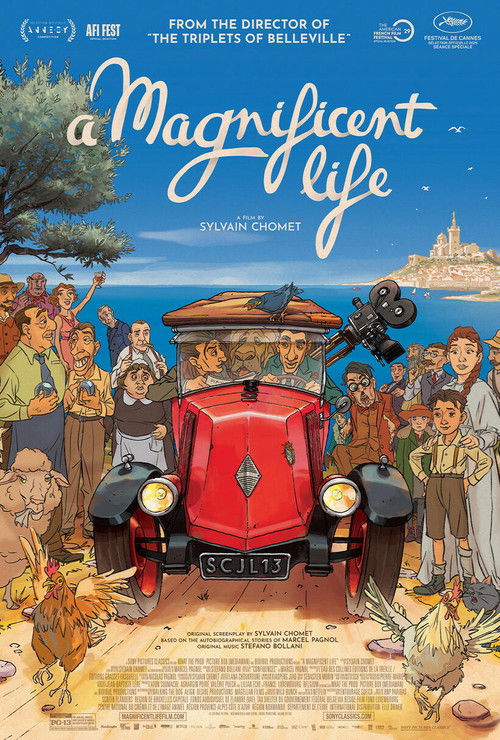
A Magnificent Life (2025)
Directed by Sylvain Chomet
No · Ultra Based
How we score movies →Consciousness Markers
Pagnol's failing memory and its effect on his creative identity receives sustained attention, and the device of a younger self appearing as a magical companion skirts the territory of dissociation and cognitive decline. It is portrayed with empathy rather than clinical framing, but the film does center the experience of a mind working differently than it once did.
The film is a hand-drawn biography of a specific historical French man, commissioned by his own grandson. The casting is governed almost entirely by fidelity to the source material, leaving essentially no room for representational engineering.
Chomet blends memory and imagination instead of presenting a factual chronological account, which introduces a degree of subjective reinterpretation. However, the film is family-approved and celebratory in intent, not revisionist in any polemical sense.
No LGBTQ+ themes, characters, or subtext are present or documented anywhere in the film's critical reception or promotional materials.
The film centers entirely on the interior life and creative legacy of a 60-year-old man. No feminist framing or agenda is present.
The film is a celebration of Provençal French cultural identity with no documented engagement with race or racial consciousness.
A biographical meditation on memory and creativity set in 1955 Provence. Climate themes are entirely absent.
No critique of capitalism, wealth, or class structures is present. The film's concerns are artistic and personal, not economic.
Body positivity is not a theme or concern of this film in any documented form.
Critics describe the film as poetic and felt. No sermonizing, messaging, or instructional energy toward the audience has been noted.
Synopsis
In 1955, 60-year-old Marcel Pagnol is a well-known and acclaimed playwright and filmmaker. When the editor-in-chief of ELLE magazine commissions a weekly column about Pagnol's childhood, he sees this as a great opportunity to go back to his artistic roots: writing. Realizing his memory is failing him and deeply affected by the disappointing results of his last two plays, Pagnol starts doubting his ability to pursue his work. That is until Little Marcel - the young boy he used to be - appears to him as if by magic. Together, they will explore Marcel Pagnol's incredible life and bring back to life his most cherished encounters and memories...
Why it received this score
Sylvain Chomet's first animated feature since 2010 arrives as a hand-drawn celebration of Marcel Pagnol, the Provençal playwright and filmmaker who defined a certain sentimental, sun-drenched vision of French life. The premise is straightforward: an aging Pagnol, memory fraying at the edges, is visited by a spectral version of his own childhood self, and together they walk back through a life of considerable artistic achievement. It is the kind of film that arrives in a velvet box, already convinced of its own preciousness. Chomet is a gifted animator, and the film is, by most accounts, lovely to look at. This is not under dispute.
What is also not under dispute, for our purposes, is that this film has essentially no interest in the progressive social preoccupations of the current moment. It is a biography of a celebrated white Frenchman, commissioned by his grandson, animated by a French auteur, and concerned almost exclusively with the interior experience of artistic aging. The closest the film comes to any of our ten markers is a gentle attentiveness to cognitive decline, rendered through the magical-realist device of the younger Marcel as companion and memory-guide. We note this, we score it modestly, and we move on. The remaining nine markers stand largely empty, like wine glasses at a temperance meeting.
The film's cultural footprint is, in the language of our methodology, essentially inert. Variety found it somewhat disappointing as biography. Annecy found it worthy of competition. The Pagnol family found it satisfactory. No discourse erupted. No thinkpieces were commissioned. In a cultural landscape that generates controversy with the enthusiasm of an industrial bakery, "A Magnificent Life" managed to arrive at Cannes and depart without a single documented argument about representation. This is, depending on your disposition, either a relief or a tragedy. We record it as a data point and retire from the room.
Analysis generated by our Consciousness Algorithm