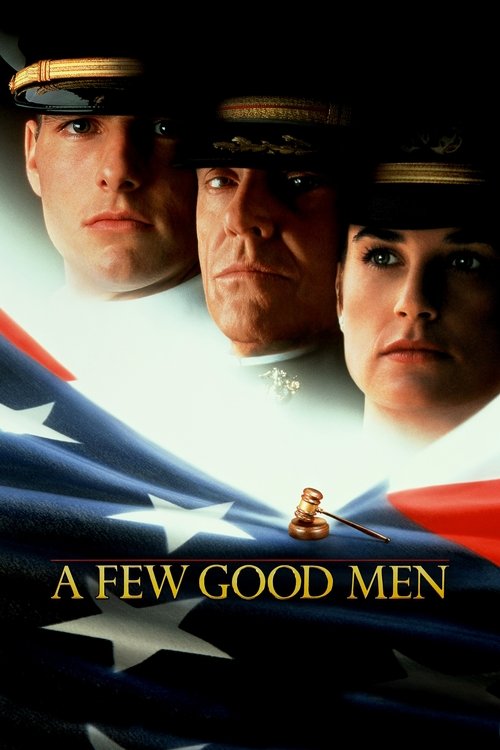
A Few Good Men (1992)
Directed by Rob Reiner
No · Based
How we score movies →Consciousness Markers
Demi Moore's character is a capable professional in a position of authority, but she remains secondary to the male protagonist and receives minimal character development focused on her identity as a woman in a male-dominated field.
The courtroom speeches, while dramatically effective, carry preachy weight about truth, justice, and institutional duty. The famous monologue presents philosophy as sermon.
While the film includes a professional woman in a significant role, it demonstrates no sustained feminist critique or consciousness. Gender dynamics are not examined as a thematic concern.
The film includes Black characters in the cast, but their roles are minor and underdeveloped. There is no exploration of racial dynamics within the military or justice system.
The film critiques institutional corruption and abuse of power, but this critique operates within a framework that accepts capitalist and military hierarchies as natural and necessary.
The film presents military and legal institutions in a largely traditional manner without questioning historical narratives or suggesting alternative interpretations of institutional legitimacy.
The film contains no LGBTQ+ themes, representation, or subtext. Sexual orientation is not addressed in any meaningful way.
Climate change or environmental concerns play no role in this military courtroom drama.
Body positivity is not a concern of this film. Casting follows conventional Hollywood standards of the early 1990s.
Neurodivergence is not represented or discussed in the film.

Synopsis
When cocky military lawyer Lt. Daniel Kaffee and his co-counsel, Lt. Cmdr. JoAnne Galloway, are assigned to a murder case, they uncover a hazing ritual that could implicate high-ranking officials such as shady Col. Nathan Jessep.
Why it received this score
A Few Good Men arrives as a product of early 1990s mainstream cinema, a time before the specific constellation of cultural sensibilities we now associate with progressive social consciousness had fully crystallized. Rob Reiner's courtroom drama concerns itself primarily with institutional accountability and the conflict between individual conscience and military authority. The film's moral universe is one of masculine competition and legal procedure, with questions of social identity treated as peripheral rather than central to its dramatic concerns.
The film's inclusion of Demi Moore as Lt. Cmdr. Galloway deserves consideration, though not the kind that contemporary frameworks might suggest. Galloway is competent, serious, and a full participant in the legal strategy. She is not, however, the protagonist, and the narrative arc belongs to Tom Cruise's Kaffee. The film does not explore her experience as a woman in a male-dominated military institution with any sustained interest. She exists within the story as a professional peer, which for 1992 represented a certain progress, but the film shows no awareness of itself as making any statement about gender representation. There is no reflexive commentary on her position, no scene dedicated to her overcoming gender-based obstacles. She is simply there, competent and underutilized.
The film's courtroom speeches, particularly Nicholson's famous monologue, carry a conservative undertone about institutional necessity and the burdens of command. There is no critique of military culture itself, no questioning of the system's legitimacy. The resolution vindicates the legal process and institutional accountability, but does not challenge the underlying power structures that produced the hazing death. For a film released in 1992, this represents neither progressive nor reactionary positioning, but rather the comfortable liberalism of mainstream American cinema of that era. It believes in law, truth, and individual heroism within existing systems rather than in systemic transformation.
Analysis generated by our Consciousness Algorithm
Critic Reviews
“That the performances are uniformly outstanding is a tribute to Rob Reiner, who directs with masterly assurance, fusing suspense and character to create a movie that literally vibrates with energy.”
“Like all courtroom dramas, A Few Good Men is gimmicky and synthetic. It's also an irresistible throwback to the sort of sharp-edged entertainment Hollywood once provided with regularity.”
“Expert story construction and compelling thesping and direction make all the narrative elements pay off as if calculated by a precision instrument in which all the parts are working perfectly.”
“The moral discussions operate like a bad pair of elevator shoes: it's obvious that their function is to lift black-and-white melodrama into message-movie paradise. The whole film, with its steady, important-picture pacing and its bits of pseudo-profundity, is a piece of glorified banality. [14 Dec 1992, p.123]”