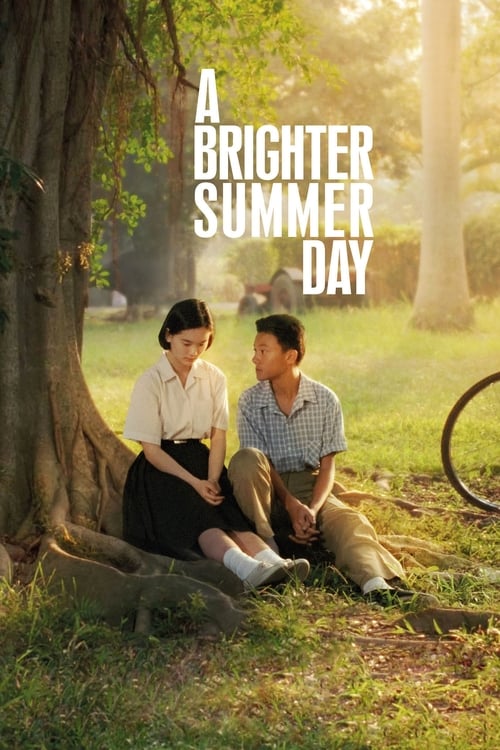
A Brighter Summer Day (1991)
Directed by Edward Yang
No · Ultra Based
How we score movies →Consciousness Markers
The film engages with historical events and the post-war Taiwanese context, but does so through period-authentic perspective rather than contemporary revisionist frameworks. It is historical documentation rather than revisionist reimagining.
The film depicts class tension and economic hardship implicitly through its portrayal of youth from working-class backgrounds, but offers no coherent anti-capitalist critique or systemic analysis. Economic conditions are background rather than subject.
The film depicts tensions between mainlander and Taiwanese populations in post-war Taiwan, but treats this as historical context rather than contemporary racial commentary. There is no modern racial consciousness framework applied to these conflicts.
Female characters exist primarily as objects within male-centered narratives. Ming-suen has minimal agency and serves as a catalyst for male violence rather than as a protagonist of her own story. No feminist critique of these dynamics is offered.
The cast reflects the Taiwanese population of 1960s Taipei naturally, but without any conscious effort toward diversity or representation beyond period accuracy. No indication of casting against type or deliberate representation strategy.
The film maintains artistic restraint and does not lecture the audience about its themes. However, its length and deliberate pacing occasionally approach preachy territory in its commitment to historical specificity.
No LGBTQ+ themes or characters are present in the film. The narrative concerns itself entirely with heterosexual relationships and masculine gang dynamics.
Climate concerns are entirely absent from this 1960s period drama about youth and crime in Taipei.
Body positivity as a modern concept is entirely absent. The film contains no commentary on body image, size acceptance, or related contemporary concerns.
No representation of neurodivergent characters or themes related to autism, ADHD, or mental health conditions as contemporary identity markers.


Synopsis
A boy experiences first love, friendships and injustices growing up in 1960s Taiwan.
Why it received this score
Edward Yang's four-hour chronicle of Taipei adolescence in 1960 stands as a monumental work of cinema, yet one entirely innocent of contemporary social consciousness markers. The film's achievement lies in its novelistic attention to texture, its patient observation of youth gang conflict, and its unflinching portrayal of violence and desire. These are virtues of artistic seriousness, not progressive sensibility. Yang captures the specific historical moment of post-war Taiwan with ethnographic precision, but there is no contemporary cultural interrogation here, no self-aware commentary on the systems his characters inhabit.
The female characters exist within the film as objects of desire and conflict rather than as autonomous agents of their own narratives. Ming-suen, the girlfriend at the center of the tragedy, functions primarily as a catalyst for masculine violence. Her agency is minimal, her perspective secondary. The film does not examine or critique this dynamic through a modern lens, nor does it center female experience or autonomy. The representation is naturalistic to the period, which is to say, it is unremarkable by 1991 standards and would be considered restrictive by contemporary expectations.
What emerges from Yang's vision is something more valuable than progressive certification: a precise, melancholic document of a moment before contemporary identity politics existed. The film's power derives from its commitment to historical specificity and emotional truth, not from any alignment with modern frameworks. It is, in this assessment, essentially a pre-contemporary artifact and should be evaluated as such.
Analysis generated by our Consciousness Algorithm
Critic Reviews
“It's in his generous, objective use of long shots and spare but startling close-ups that we see once again the influence of Robert Altman in Yang's aesthetic and the struggle of the Taiwanese people to accept their history. In essence, Yang uses his aesthetic to bring into the light that which is dark. ”
“There is nothing like nostalgia here, but in the quiet consideration of how these days actually passed—what was dear about them, what was dangerous, and what has been irrevocably lost since then—A Brighter Summer Day gives early teen life, in all its complexity, a burnished reverence.”
“It is a crowded, complex crime story that is also a tale of sexual awakening and an understated exercise in kitchen-sink realism. In short - or rather at mesmerizing, necessary length - this film has everything, and is well worth a day of your life. ”
“What makes this such a striking film is how the larger scope works perfectly in tandem with the very specific time and setting. ”