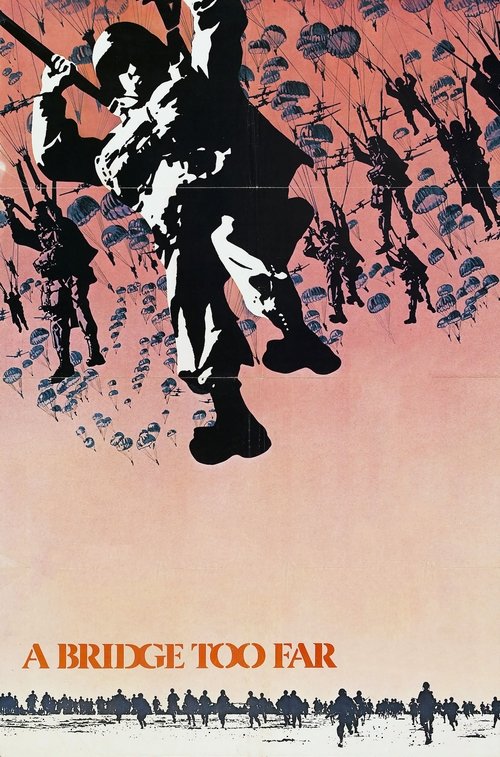
A Bridge Too Far (1977)
Directed by Richard Attenborough
No · Ultra Based
How we score movies →Consciousness Markers
The film attempts historical accuracy regarding Operation Market Garden but necessarily simplifies complex events and centers Allied perspective. Some compression of events for narrative purposes occurs.
The film features primarily white Western Allied forces. Black soldiers and other racial minorities are largely absent from the narrative, reflecting both historical erasure and 1970s casting practices.
The film is preachy in its presentation of military strategy and tactical information, but this serves historical documentation rather than contemporary social messaging.
The film features an all-male ensemble cast of international stars. Women appear only in peripheral roles as nurses or civilians with no agency in the narrative.
The film depicts military hierarchy and command structure but does not critique capitalism or economic systems. Military logistics are treated as technical problems rather than ideological ones.
The film contains no feminist perspective or critique. Women are absent from decision-making and action, appearing only as supporting figures in a male-dominated narrative.
No LGBTQ+ themes, representation, or acknowledgment appear in this 1977 war film focused entirely on heterosexual male military personnel.
Climate concerns have no relevance to this historical war drama set in 1944 and released in 1977, prior to climate consciousness entering mainstream filmmaking.
Body positivity discourse is entirely absent from this military drama, which focuses on able-bodied soldiers and treats injury as tragic consequence rather than subject of reflection.
The film contains no acknowledgment of or representation related to neurodivergence, mental health, or disability in any progressive sense.


Synopsis
The story of Operation Market Garden—a failed attempt by the allies in the latter stages of WWII to end the war quickly by securing three bridges in Holland allowing access over the Rhine into Germany. A combination of poor allied intelligence and the presence of two crack German panzer divisions meant that the final part of this operation (the bridge in Arnhem over the Rhine) was doomed to failure.
Why it received this score
Richard Attenborough's sprawling 1977 war epic presents itself as a monument to historical seriousness, a three-hour-plus exercise in tactical narrative featuring an ensemble cast of sufficient wattage to power a small nation. The film concerns itself exclusively with the mechanics of Operation Market Garden, that failed attempt to end World War II by the autumn of 1944. In this regard, it succeeds entirely as a product of its era: a prestige historical drama that treats military strategy with the gravity of classical literature. There are no women in meaningful roles. The narrative focuses almost entirely on the perspectives and decision-making of Allied command, with German forces rendered as obstacles rather than subjects of narrative interest. The film is interested in the war as a problem to be solved by men of rank and intelligence.
What we have here is a film that exists prior to the cultural frameworks we now associate with progressive social consciousness. The all-male cast, the colonial undertones of the operation itself, the absence of any reflection on the violence being depicted—these are not progressive choices, nor are they regressive ones. They are simply the default assumptions of 1977 cinema, which had not yet begun the process of interrogating its own perspective. Attenborough was a liberal humanist committed to serious filmmaking, but "serious" in that era meant something quite different from what it means now. The film's interest in depicting failure, in showing how bureaucratic miscalculation and intelligence failures led to unnecessary death, might be read as a critique of military authority, but such readings would be generous.
This is a film that exists in a pre-woke universe, which is to say it is a film from before the specific cultural markers we now measure had been established as matters of conscious choice. It is neither ahead of its time nor behind it in the way contemporary discourse understands those categories. It is simply a product of its moment: an expensive, well-crafted, entirely male-centered historical drama that assumes the audience requires no alternative perspectives to understand the human cost of war.
Analysis generated by our Consciousness Algorithm
Critic Reviews
“Not only did surviving vets get to see their World War II exploits (in the September 1944 Arnhem debacle) played out spectacularly for all the world to see, but several got to coach the actors playing them. [28 Dec 2001]”
“An absorbing, well-crafted, honorable movie that seems almost as ambitious as the original operation itself. [20 Jun 1977, p.65]”
“First-rate blockbuster preaching an anti-war message but laying on grand battle sequences as it recreates, coherently and convincingly, Operation Market Garden, the Allied Forces' airborne assault on Arnhem in 1944 that was intended to end the Second World War by Christmas. [19 Nov 2006, p.2]”
“A Bridge Too Far is a fantastic historical and cinematic achievement but, if you're not a die-hard war obsessive, prepare to snooze.”