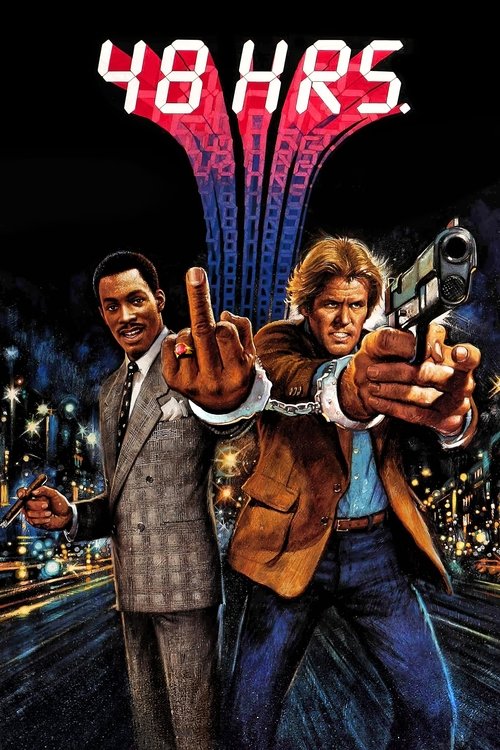
48 Hrs. (1982)
Directed by Walter Hill
No · Ultra Based
How we score movies →Consciousness Markers
The film features an interracial pair as leads, which was notable for 1982, but the casting appears more opportunistic than purposeful. Murphy's role, while significant for his career, largely follows comedic sidekick conventions of the era.
While the film features interracial partnership, it exhibits no conscious engagement with racial dynamics or systemic issues. The racial element serves as comedic structure rather than social commentary.
The film includes female characters but treats them as secondary plot devices. Annette O'Toole's role is minimal and her agency is limited to supporting the male leads.
The film follows a standard buddy cop formula where authority is ultimately upheld. There is no critique of capitalism or institutional power structures.
The film is primarily focused on entertainment and action sequences. Any moments of dialogue that might be mistaken for social commentary are incidental to plot mechanics.
No LGBTQ+ themes or representation present in the film.
No climate-related themes or environmental consciousness present in this action-comedy.
No body positivity themes or relevant commentary present in the film.
No representation of or engagement with neurodivergence in the narrative.
The film makes no attempt to reframe historical events or narratives. It is set in contemporary times with no historical pretensions.


Synopsis
A hard-nosed cop reluctantly teams up with a wise-cracking criminal temporarily paroled to him, in order to track down a killer.
Why it received this score
Walter Hill's 48 Hrs. presents the curious case of a film that appears superficially progressive in its casting choices yet remains fundamentally uninterested in any particular social consciousness. The pairing of Nick Nolte's cynical cop with Eddie Murphy's wisecracking convict was novelty enough for 1982, marking Murphy's breakthrough role, but the film treats this racial dynamic as a comedic premise instead of a subject worthy of examination. The criminal and the cop dislike each other, they learn to work together, and we are meant to find humor in their mutual irritation. That this involved a Black man and a white man was simply the joke structure the screenwriters selected.
The film's approach to its interracial buddy dynamic feels almost aggressively neutral on matters of social consciousness. There is no moment where the script pauses to acknowledge racial tension, systemic inequality, or anything beyond the immediate mechanics of plot. Murphy's character exists primarily as a vehicle for one-liners and comic relief, which was the standard function of such roles in the early 1980s. His criminality is treated as personal failings rather than social commentary, his wit as entertainment rather than resistance, his Blackness as incidental to the action.
A film that achieved cultural significance through casting alone, not through intent. 48 Hrs. benefited from changing demographics in Hollywood audiences and the natural charisma of its leads, but it evinces no particular investment in progressive themes or cultural awareness as we understand those terms today. It is a competent action-comedy that happened to star an interracial pair at a moment when such pairings were still novel enough to draw attention. That it was commercially successful and artistically respectable speaks to its qualities as entertainment, not as a vehicle for social consciousness.
Analysis generated by our Consciousness Algorithm
Critic Reviews
“What makes the movie special is how it's made. Nolte and Murphy are good, and their dialogue is good, too - quirky and funny.”
“Together Cates and Hammond take a thrill-a-minute trip through the San Francisco underworld and along the way develop one of the 1980s' more interesting cinematic buddy pairings.”
“That the fact they come to appreciate one other, the grudging respect of a million clichés, feels so satisfyingly, shows just how successful the film is.”
“Neither jokes nor fast, flashy action can completely distract audiences from the failure to establish an authentic, rather than a purely conventional connection between Nolte and Murphy.”