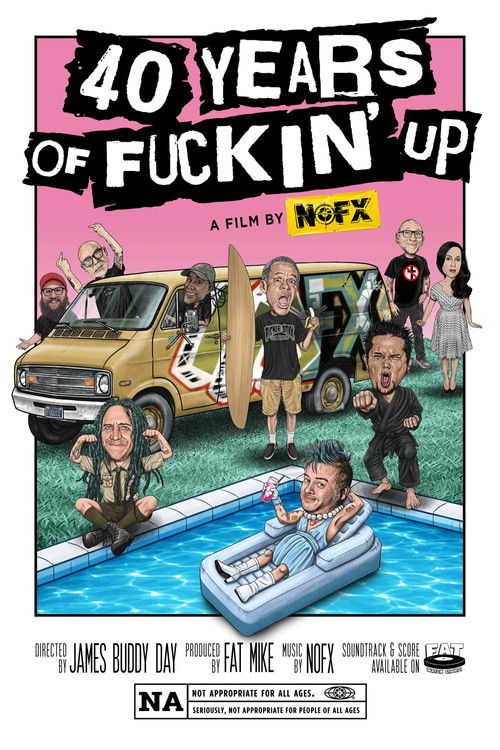
40 YEARS OF FUCKIN' UP (2026)
Directed by James Buddy Day
Partly · Woke-Adjacent
How we score movies →Consciousness Markers
The band's anarchist leanings, anti-establishment messaging, and skepticism toward selling out provide genuine anti-capitalist posturing. However, the band has also built infrastructure within the punk industry, complicating any pure anti-capitalist stance.
Fat Mike's queerness is acknowledged in scholarly analysis of the band, and gender and sexuality themes appear in their music. However, this emerges organically from the band's history rather than being a central focus of the documentary.
The documentary celebrates punk's refusal to preach and NOFX's commitment to provocation over pedagogy. However, anti-war messaging and anti-establishment politics do carry some preachy weight, even if delivered through chaos rather than clarity.
While NOFX has engaged with gender issues in their provocative music, the documentary does not appear to center feminist analysis. The band's approach to gender has historically been more transgressive than explicitly feminist.
The documentary features the band members themselves, all of whom are white men. While the film may include diverse voices in interviews, the primary subjects are not representative of broader diversity.
The documentary presents the band's history as they lived it, including their provocations and controversies. While not sanitizing the past, it does not appear to substantially revise historical narratives in a progressive direction.
While Fat Mike has publicly discussed anxiety and panic attacks, the documentary does not appear to center neurodivergence as a social consciousness theme or advocacy point.
No evidence suggests body positivity or body acceptance is a theme in the documentary or the band's broader project. This appears unrelated to their primary concerns.
NOFX's music and legacy do not appear to emphasize climate activism or environmental consciousness. Climate themes are absent from the documentary's described scope.
No evidence in available materials suggests the documentary addresses racial themes or racial consciousness as a significant component of the band's legacy or the film's narrative.
Synopsis
The Truth Behind The Insanity of The Iconic Punk Band NOFX
Why it received this score
NOFX has spent four decades perfecting the art of righteous noise, and this documentary captures a band caught between genuine political conviction and the performative contradictions that come with commodifying dissent. The band's anti-war stance, anarchist leanings, and genuine engagement with queer identity provide some scaffolding for progressive sensibilities, yet the film seems more interested in celebrating punk's raw authenticity than in advancing any coherent social analysis. Fat Mike and company have always trafficked in provocation for its own sake, a stance the documentary appears to honor rather than interrogate.
The unfiltered approach that director James Buddy Day brings to the material is precisely where the social consciousness becomes muddled. We are presented with the band's messy history, their contradictions, their provocations, and their occasional stumbles into genuinely problematic territory, all with the implicit suggestion that this rawness is somehow more honest than a carefully curated narrative. This is punk's eternal bargain: the refusal to be polished, to be digestible, to be acceptable. But punk aesthetics and progressive politics are not the same thing, and the documentary never quite resolves this tension.
The band's skepticism toward power structures aligns with anti-capitalist impulses, their engagement with gender and sexuality provides credibility on LGBTQ+ fronts, and their anti-war messaging has real historical weight. Yet the documentary's refusal to contextualize or critique their own provocations, their occasional lapses into offensive territory, and their commitment to entertainment over education means this is more accurately a celebration of punk iconoclasm than a document of progressive filmmaking. The band's political positions emerge through the chaos rather than being interrogated by it.
Analysis generated by our Consciousness Algorithm