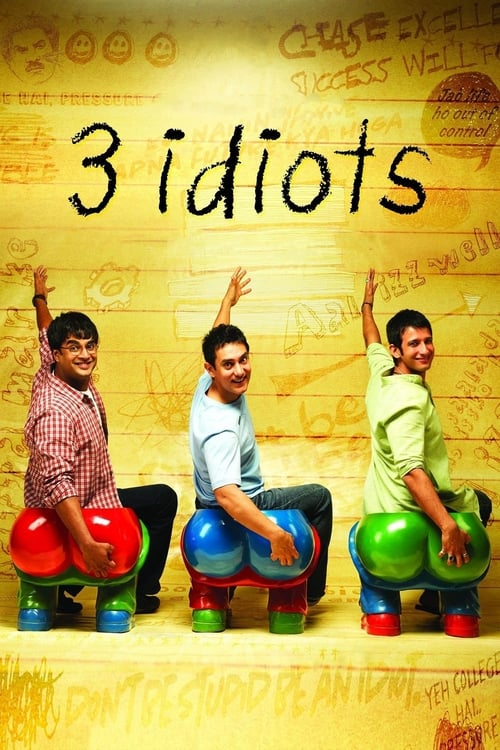
3 Idiots (2009)
Directed by Rajkumar Hirani
No · Based
How we score movies →Consciousness Markers
The film frequently breaks into preachy monologues about the failures of the education system and the importance of passion over credentials. While thematically progressive, these moments prioritize explicit messaging over subtle storytelling.
The film critiques individual greed, corporate careerism, and the commodification of education, celebrating passion and creativity over material success. However, it lacks systemic analysis and proposes only individual enlightenment as an alternative.
The film features an all-Indian cast in a major Bollywood production, which is unremarkable for the industry. However, the representation remains limited to conventional Bollywood archetypes without deliberate diversification or intentional counter-casting.
Female characters are underdeveloped and primarily function as romantic interests or decorative elements. Kareena Kapoor Khan's character exists mainly to create romantic tension, while Mona Singh has minimal narrative importance. No genuine exploration of women's autonomy or perspective.
No LGBTQ+ themes, representation, or acknowledgment present in the film. The narrative is entirely heteronormative with no meaningful engagement with queer identity or experience.
The film does not engage with questions of caste, religious identity, or racial dynamics within the Indian context. Characters are presented without meaningful exploration of how these identities might shape their experiences.
No environmental or climate-related themes present in the narrative. The film shows no concern with ecological consciousness or sustainability.
No meaningful engagement with body positivity or diverse body representation. The film adheres to conventional Bollywood beauty standards without deliberate counter-representation.
No representation of neurodivergent characters or engagement with disability, neurodiversity, or mental health accommodation as meaningful themes.
The film contains no historical revisionism or reframing of established historical narratives. It focuses on contemporary institutional critique rather than historical analysis.


Synopsis
Rascal. Joker. Dreamer. Genius... You've never met a college student quite like "Rancho." From the moment he arrives at India's most prestigious university, Rancho's outlandish schemes turn the campus upside down—along with the lives of his two newfound best friends. Together, they make life miserable for "Virus," the school's uptight and heartless dean. But when Rancho catches the eye of the dean's daughter, Virus sets his sights on flunking out the "3 idiots" once and for all.
Why it received this score
3 Idiots presents itself as a film of considerable social consciousness, attacking the Indian education system's obsession with rote learning and corporate careerism in favor of passion and self-actualization. The film's central thesis, that rigid institutional frameworks crush human potential, carries echoes of the anti-establishment sentiments that would later become fashionable in progressive circles. Yet by the standards of modern social consciousness, the film remains stubbornly conventional in its blind spots. The female characters exist primarily as romantic interests and objects of desire rather than autonomous agents with their own arcs of development. Kareena Kapoor Khan's role as Virus's daughter serves mainly to provide romantic tension and motivation for the male leads, while Mona Singh's appearance is largely decorative.
The film's critique of capitalism, while present, lacks the systemic analysis that contemporary progressive sensibilities demand. Where it attacks individual greed and the worship of material success, it does not interrogate the structures that produce such values, nor does it propose alternatives beyond individual enlightenment and artistic fulfillment. The representation of characters from working-class backgrounds is sympathetic but ultimately patronizing, treating poverty as a plot device rather than as a lived reality deserving sustained attention. The film's celebration of intellectual excellence and innovation, while philosophically anti-authoritarian, remains meritocratic in its worldview.
What rescues the film from a lower score is its genuine commitment to questioning institutional authority and its refusal to endorse the path of complicit careerism. The film's attack on the education system's soul-crushing mechanisms carries real bite, and its celebration of friendship and human connection over status accumulation reflects values that align, if only partially and accidentally, with broader progressive sensibilities. Yet these moments of alignment feel incidental rather than central to the film's concerns, and the absence of any meaningful engagement with questions of representation, identity, or structural inequality keeps this from being anything more than a moderately conscious cultural product.
Analysis generated by our Consciousness Algorithm
Critic Reviews
“There's an unavoidable joie de vivre (symbolized by Rancho's meditative mantra "All is well") and a performance charm that make this one of the more naturally gregarious Bollywood imports.”
“3 Idiots takes a while to lay out its game plan but pays off emotionally in its second half.”
“In writer-director Rajkumar Hirani's tuneful, enjoyable college comedy, 3 Idiots, Khan plays "Rancho," an engineering student so brilliant that he barely has to break a sweat to place first in his class.”
“The film's good points, though, are marred by a slow start and a nerve-jangling soundtrack.”