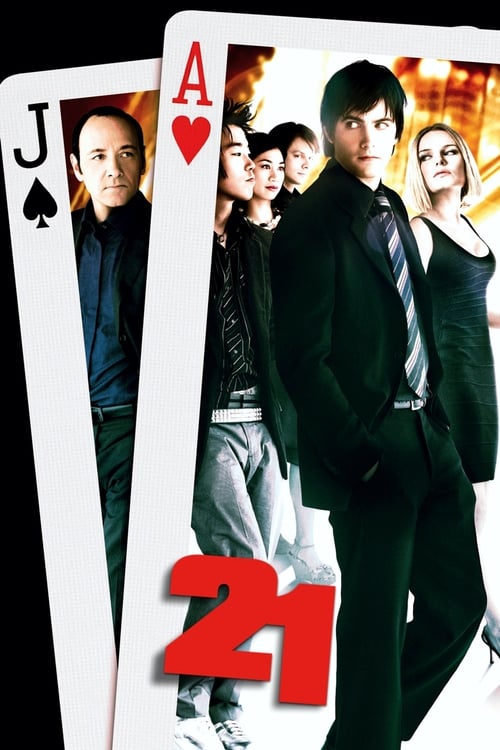
21 (2008)
Directed by Robert Luketic
No · Ultra Based
How we score movies →Consciousness Markers
The film revises the actual MIT blackjack team's composition, centering white characters over the Asian American students who were historically central to the team.
The film casts Jim Sturgess as the lead despite the real MIT team's significant Asian American membership, effectively centering a white protagonist over the historical reality. Supporting Asian American characters exist but occupy secondary roles.
Kevin Spacey's mentor character occasionally delivers exposition about mathematics and strategy, but this is minimal and serves the plot rather than creating preachy messaging.
No LGBTQ+ themes, characters, or representation present in the film.
No feminist agenda or gender consciousness evident. Female characters are minimal and underdeveloped.
The film demonstrates no awareness of its own whitewashing of the source material. No racial themes or consciousness appear in the narrative.
No climate-related themes, messaging, or content present.
The film celebrates wealth accumulation and clever exploitation of systems. No critique of capitalism or class systems appears.
No body positivity messaging or diverse body representation present.
No neurodivergence representation or themes present in the film.


Synopsis
Ben Campbell is a young, highly intelligent student at M.I.T. who strives to succeed. Wanting a scholarship to transfer to Harvard School of Medicine to become a doctor, Ben learns that he cannot afford the $300,000 tuition as he comes from a poor, working-class background. But one evening, Ben is introduced by his unorthodox math professor to a small but secretive club of five students, Jill, Choi, Kianna, and Fisher, who are being trained by Professor Rosa to count cards at blackjack.
Why it received this score
21 is a textbook example of the pre-woke era's approach to adaptation and representation, which is to say it demonstrates the kind of choices that would later inspire considerable soul-searching. The film tells the story of the MIT blackjack team with a narrative restructuring that prioritizes a white protagonist at the expense of the Asian American students who were central to the actual enterprise. Jim Sturgess receives top billing and narrative focus, while Aaron Yoo and Liza Lapira, despite their presence in the cast, occupy supporting roles in a story that originally belonged equally to them. This casting choice reflects the commercial calculations of 2008 cinema, when studios believed bankability flowed through white leads.
The film contains no evidence of feminist consciousness, climate messaging, disability representation, or anti-capitalist critique. Indeed, it celebrates the accumulation of wealth through clever manipulation of systems. There is no attempt at racial consciousness regarding its own narrative choices, no LGBTQ+ content, and no body positivity or neurodivergence representation. The lecture energy is minimal, though Kevin Spacey's mentor character delivers occasional homilies about mathematics and cunning. The film operates within a framework of traditional entertainment priorities, treating its source material as raw material to be reshaped for commercial appeal rather than as a story whose specific details and demographics matter.
What emerges is a genuinely entertaining casino heist film that happens to be structured around a failure of representation. The irony is particularly sharp because the film is based on a true story, one in which the diversity of the team was integral to the narrative, yet the adaptation actively works against that inheritance. By 2024 standards, this would be immediately flagged as problematic. In 2008, it was simply business as usual.
Analysis generated by our Consciousness Algorithm
Critic Reviews
“21 drags itself to a climax that puts credulity in splints. So what? In a multiplex of dumb-luck hits, it's a kick to watch Spacey and a gifted young cast use smarts to deal audiences a winning hand.”
“The fun of 21 is the way that this sharp, hyperaware star in the making, his face as readable as a mood ring, pours us into an adrenalized cocktail of fear, desire, and mental buzz.”
“21 makes for some slick escapist fantasy. Even if, and because, the fantasy has its roots in something real.”
“A movie that wastes a lot of time and money and really, REALLY shoulda stayed in Vegas.”