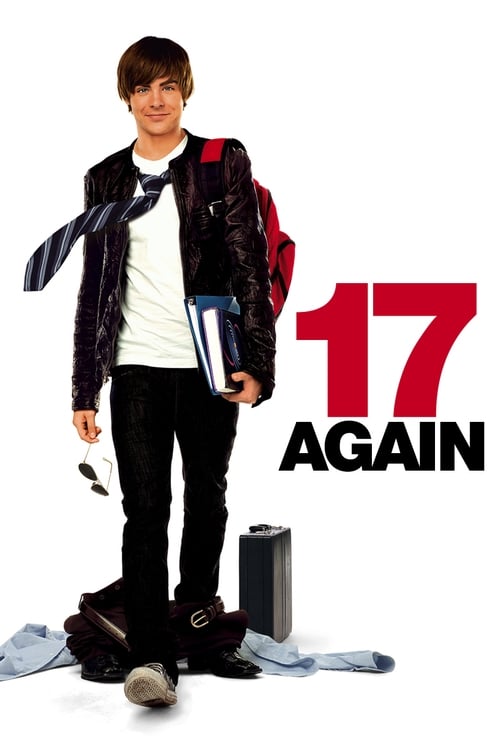
17 Again (2009)
Directed by Burr Steers
No · Ultra Based
How we score movies →Consciousness Markers
While the film is primarily comedic, it contains some preachy moments where the protagonist dispenses wisdom to teenagers about life choices and relationships, occasionally veering toward moralizing about adulthood.
The cast is predominantly white, with Leslie Mann as the female lead and a supporting ensemble that lacks meaningful diversity. Zac Efron's casting as the teenage version of a middle-aged man follows conventional Hollywood beauty standards.
Leslie Mann's character functions primarily as the love interest and ex-wife whose main arc involves reconciliation with the male protagonist. She lacks agency beyond her relationship to Mike and exists to validate his personal growth.
The protagonist's arc involves finding fulfillment outside career success, but this is presented as personal redemption rather than systemic critique. Capitalism itself is not interrogated.
No LGBTQ+ themes, representation, or subtext are present in the film. The narrative centers exclusively on heterosexual romance and reconciliation.
The film contains no racial consciousness, commentary on systemic inequality, or meaningful exploration of race. Minority characters, if present, are incidental to the narrative.
Environmental concerns are entirely absent from the film. No climate-related themes, activism, or consciousness appear in the narrative.
The entire premise relies on the desirability of a youthful, conventionally attractive body. The film celebrates physical transformation into a more attractive form without any ironic commentary on beauty standards.
No neurodivergent representation or themes appear in the film. No characters with autism, ADHD, dyslexia, or other neurodivergent conditions are present.
The film does not engage with historical narratives or attempt to reframe historical events. It is a contemporary romantic comedy without historical pretensions.


Synopsis
On the brink of a midlife crisis, 30-something Mike O'Donnell wishes he could have a "do-over." And that's exactly what he gets when he wakes up one morning to find he's 17 years old again. With his adult mind stuck inside the body of a teenager, Mike actually has the chance to reverse some decisions he wishes he'd never made. But maybe they weren't so bad after all.
Why it received this score
17 Again arrives as a thoroughly conventional romantic comedy, one that mistakes nostalgia for wisdom and physical transformation for character development. The premise itself is fundamentally conservative: a man who abandoned his family for career ambitions gets a chance to redo his teenage years, only to discover that his actual life, complete with ex-wife and children, was worth preserving all along. This is not progressive messaging. This is a paean to heterosexual reconciliation and the nuclear family structure, delivered with the sincerity of a greeting card.
The film's relationship to contemporary cultural consciousness is one of studied indifference. Zac Efron's casting as the teenage version of Mike O'Donnell operates entirely within conventional beauty standards, and the narrative derives much of its humor from placing this conventionally attractive body into awkward social situations. There is no interrogation of body image, no commentary on ageism or masculinity, no recognition that the entire fantasy is predicated on the desirability of youth and conventional attractiveness. The ensemble cast lacks meaningful diversity, and Leslie Mann's role, while present, remains subordinate to the male protagonist's arc of self-discovery.
What passes for social awareness in 17 Again amounts to gentle moralizing about priorities and family values. The protagonist learns that being present matters more than professional success, a lesson delivered with the subtlety of a school assembly. This is humanism, not social consciousness. It is a film about personal redemption rather than systemic critique, about individual choices rather than structural inequality. For a work attempting to engage with contemporary sensibilities, it remains resolutely uninterested in the mechanisms of social progress.
Analysis generated by our Consciousness Algorithm
Critic Reviews
“Pleasant, harmless PG-13 entertainment, with a plot a little more surprising and acting a little better than I expected.”
“Though there's nothing revolutionary about 17 Again, the movie is undeniably enjoyable.”
“While the movie feels shelf-worn, Efron's performance is fresh.”
“If this is one small step for the actor (Efron) toward becoming a leading man, it is, for Hollywood movies, one more giant leap into infantilism.”