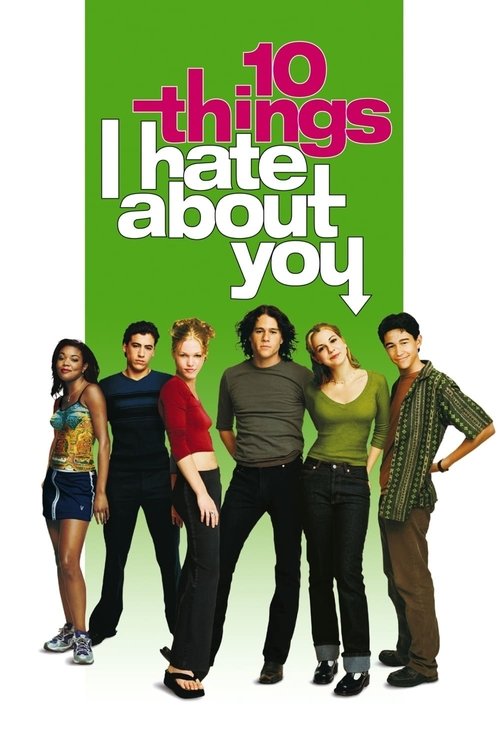
10 Things I Hate About You (1999)
Directed by Gil Junger
No · Based
How we score movies →Consciousness Markers
Kat Stratford presents as intellectually independent and resists romantic pressure, but the film's central narrative arc involves her being 'tamed' by male romantic pursuit, ultimately undermining any feminist message through capitulation to the romance plot.
Gabrielle Union appears as Chastity, a Black student in a supporting role, but the character is thinly drawn and primarily functions as a popular girl without meaningful development or thematic significance.
Kat delivers earnest monologues about independence and rejecting societal pressure, but these function as character moments rather than preachy lectures directed at the audience.
The film contains casting diversity but demonstrates no explicit racial consciousness or thematic engagement with race and identity.
No LGBTQ+ characters, themes, or representation present in the film.
No climate-related themes, messaging, or environmental consciousness present in the film.
The film presents a thoroughly consumerist high school world without critique or anti-capitalist messaging.
No body positivity messaging or inclusive representation of diverse body types; operates within standard 1990s beauty standards without commentary.
No representation of neurodivergent characters or engagement with neurodivergence as a theme.
While loosely adapted from Shakespeare's 'The Taming of the Shrew,' the film does not engage in historical recontextualization or revisionist framing.


Synopsis
On the first day at his new school, Cameron instantly falls for Bianca, the gorgeous girl of his dreams. The only problem is that Bianca is forbidden to date until her ill-tempered, completely un-dateable older sister Kat goes out, too. In an attempt to solve his problem, Cameron singles out the only guy who could possibly be a match for Kat: a mysterious bad boy with a nasty reputation of his own.
Why it received this score
10 Things I Hate About You arrives from a pre-woke era with the earnest charm of a teen romantic comedy that imagines independence and wit as the highest virtues a high school girl might possess. Julia Stiles' Kat Stratford stands as an island of intellectual resistance in a sea of mall-adjacent conformity, rejecting the social machinery that demands she perform femininity on schedule. She reads Sylvia Plath, objects to the commodification of women, and speaks her mind with theatrical precision. One must appreciate the film's commitment to the bit, even if the bit itself is fundamentally about how much more attractive a woman becomes once she stops being difficult.
The narrative architecture, however, betrays any progressive intentions lurking in the margins. The entire film is structured around the premise that Kat's independence is a problem requiring correction through romance. Heath Ledger's Patrick Verona exists solely to soften her edges, to make her vulnerable, to transform her from an obstacle into a prize. By the final act, Kat has been successfully tamed, her resistance reframed as a defense mechanism that love has healed. The film presents this as triumph rather than capitulation, which is the classical move of romantic comedy but hardly the move of a work engaged with contemporary gender consciousness.
The film's casting includes Gabrielle Union, but her presence functions as set dressing in a white-centered narrative, a detail rather than a statement. Nothing in the film suggests awareness of her character as anything other than a popular girl in a teenage hierarchy. This is 1999 Hollywood diversity, which is to say diversity without intention or consequence. The production operates within the consumerist, heteronormative, able-bodied world of mainstream teen cinema without irony or interrogation. It is a perfectly serviceable comedy that has aged into something more interesting by accident than by design.
Analysis generated by our Consciousness Algorithm
Critic Reviews
“It's a celebration of young American women, finding them smarter, tougher, shrewder, more rigorous, more persistent and more honest than any movie in many a moon.”
“A small-scale, slight undertaking, but its pleasures are unexpectedly rich. It has become a habit in our movies to portray the exploits of high school characters as shocking and depraved. Ten Things allows its teenagers their innocence and a quality that is even rarer these days, something like nobility.”
“Lutz's dialogue is consistently sharp and snappy, and the large cast forms a sparkling ensemble under Junger's adept direction.”
“It wimped out by blanding down the story and the characters to the point where she isn't really a shrew and he isn't really a maniac.”