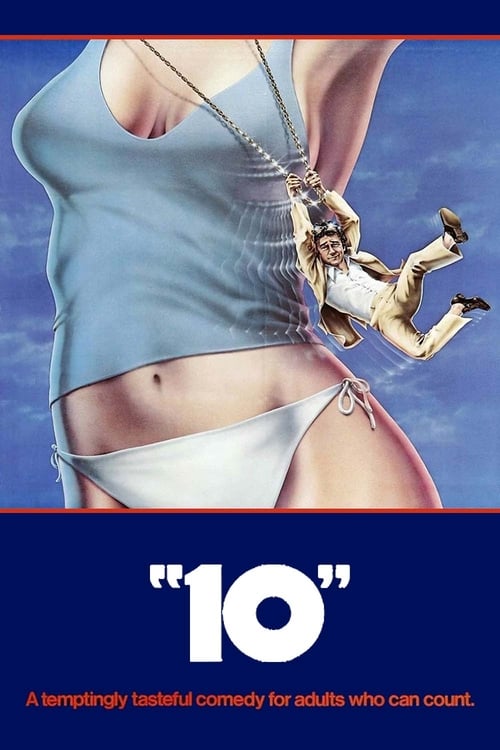
10 (1979)
Directed by Blake Edwards
No · Ultra Based
How we score movies →Consciousness Markers
Cast includes some female roles, but they are written with minimal agency or dimension. Bo Derek is cast primarily for appearance, and other female characters serve supporting functions in the male protagonist's narrative.
The cast is predominantly white. There is no demonstrated awareness of racial issues or effort toward meaningful representation, though this is consistent with mainstream Hollywood comedy of the late 1970s.
The film is actively antithetical to feminist sensibilities, centering male desire and treating female characters as objects to be pursued rather than people with agency or subjectivity.
The film's entire premise depends on narrow beauty standards and the numerical rating of female attractiveness. It actively works against body positivity by making physical appearance the sole measure of female value.
No LGBTQ+ themes, representation, or content of any kind.
No climate-related themes or environmental consciousness present in the film.
The film makes no critique of capitalism or wealth. The protagonist is a successful Hollywood composer whose crisis is personal rather than systemic.
No representation of or engagement with neurodivergent characters or perspectives.
The film contains no historical content or revisionist historical interpretation.
The film does not attempt to educate or preach about social issues. It is a straightforward romantic comedy without preachy intent.


Synopsis
A Hollywood songwriter goes through a mid-life crisis and becomes infatuated with a sexy blonde newlywed.
Why it received this score
Blake Edwards' "10" is a film so thoroughly committed to the male gaze that it functions as a sort of cultural artifact from a different era, one in which a woman's value could be quantified on a numerical scale without irony or self-awareness. The film tracks a middle-aged composer's descent into obsessive fantasy over an attractive woman he glimpses on her wedding day, a premise that treats female agency as decorative background to male desire. What we observe is not so much a love story as a clinical study in male entitlement masquerading as romantic comedy.
The film's approach to women exists almost entirely within the framework of male perception. Julie Andrews appears as the protagonist's ex-wife, present mainly to serve as the launching pad for his crisis and infidelity. Bo Derek, the object of his obsession, functions as a blank canvas for projection rather than a character with interiority. The supporting female characters exist primarily to facilitate the male fantasy or provide commentary on it. There is no sense here that the film understands women as autonomous agents with their own desires, conflicts, or subjectivity.
What prevents this from scoring even lower is the simple fact that "10" predates the contemporary markers we examine by several decades. It reflects the casual misogyny of its era rather than performing it as a conscious ideological position. The film is not trying to make a progressive statement it fails to achieve, nor is it attempting to deconstruct male desire in ways that fall short. It is simply a product of its time, when such entertainment could be produced without the burden of modern cultural consciousness. In that sense, it earns its minimal score not through any merit of progressive sensibility, but through historical distance and the basic absence of deliberate engagement with the issues we measure.
Analysis generated by our Consciousness Algorithm
Critic Reviews
“Blake Edwards's "10" is perhaps the first comedy about terminal yearning. Like all great comedies, it deals with emotions very close to our hearts: In this case, the unutterable poignance of a man's desire for a woman he cannot have.”
“Blake Edwards's riotous, deeply felt "10" proves just how many fresh turns are left on this well-traveled road and demonstrates again that a gifted writer-director can convert the most conventional commercial formulas into a movie as personal, in its way, as "Apocalypse Now." Edwards provides the side-splitting slapstick one expects from the maker of five "Pink Panther" movies, but he gives us something more: an introspective, bittersweet comedy of manners about a man whose voyeurism prevents him from seeing himself...This is the sort of classical Holly wood comedy that will still look good in 30 years. [15 Oct 1979, p.133]”
“Blake Edwards's frequently hilarious new film, “10,” is the story of George's desperate efforts to come to terms with life in Southern California even though he knows he's inadequate.”
“The biggest anti-bonus of all, however, is the subject itself: running amok in middle-age. The French have already gnawed that particular turkey meatless. Now it has been passed to North Americans, who are picking the bones. Those bones rattle. [6 Oct 1979]”